Secondary Growth: A Short History of Heath Creek and Norway Valley
One of the largest parts of our natural lands is restored prairie. Despite our love for big and little bluestem, this side of the cannon river was historically the big woods biome rather than prairie. Big Woods is an ecosystem that has almost completely disappeared with human modifications, the largest stand of which is located at Nerstrand state park. However, a little known fact about the natural lands is that we have a sneaky little secondary growth section of Big Woods in the natural lands, as well as some very old open grown oaks.


Aerial photo from 1937 showing Heath Creek and Norway Valley as compared to today. From Minnesota Historical Aerial Photographs Online and Google Maps.
Norway Valley is often overlooked in discussions about the natural lands, but despite being tucked tightly away behind Regents, Norway Valley has a very important ecological significance. The land was originally the Big Woods biome, as it is now, until it was sold to the college and the original owner used the original trees for logging. After all of the harvestable trees had been cut down, the smaller trees that were left behind filled in the empty spaces. Saplings which evaded the first round of logging essentially re-established the woods. This is what we call a secondary growth forest, as the trees are made up of older saplings. These established trees are over 100 years old, making Norway Valley one of the oldest existing woodland areas on campus.
Norway Valley’s ecosystem thrives on dark and shaded areas. The two primary trees that grow in Norway Valley are Sugar Maple and Basswood. Basswood trees are shade tolerant making them fantastic co-habitators with Sugar Maple. Where sunlight permits, you may see some oak or hickory trees. The understory iis incredibly slim due to this intense shade coverage. Additionally, due to its soil type and formation as a valley, Norway Valley is incredibly moist. Mushrooms like the Artist’s Bracket and Mossy Maze Polypore can frequently be found here, due to the amount of decaying hardwood trees and the inherent moisture in the air.
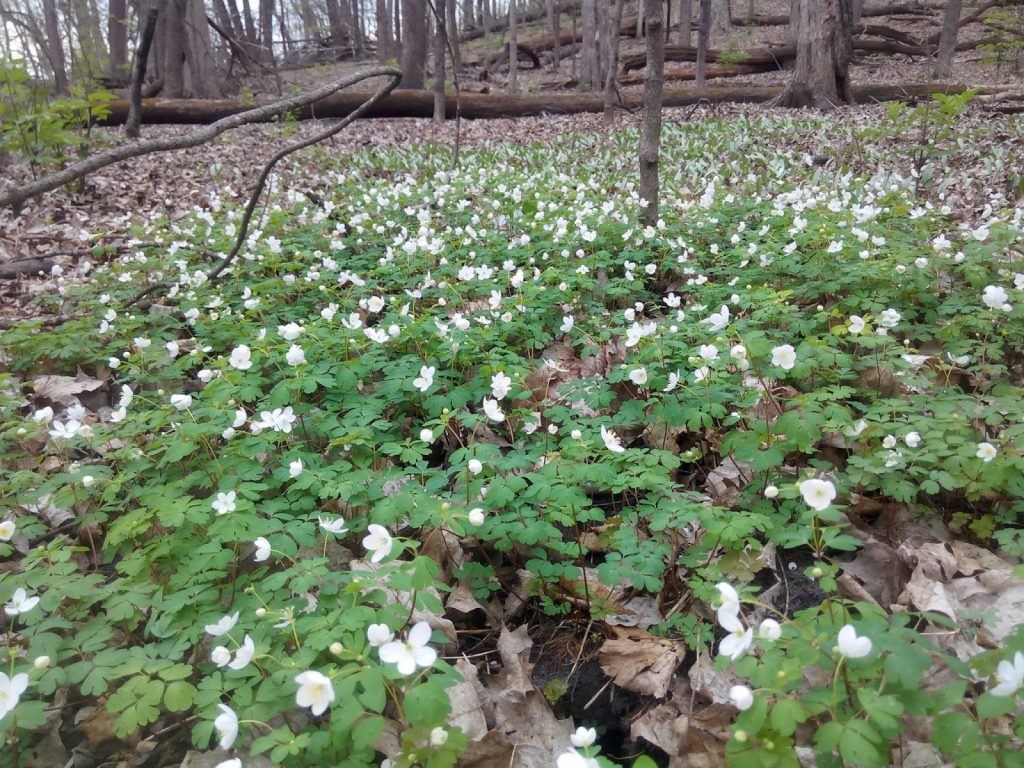
However, we are on the cusp of an exciting ephemeral event in Norway Valley, one that has been happening long before Norway Valley was logged or settlers had even come to the US. Every spring, for a few weeks, deathly Norway Valley is filled with life. After it warms up and before the trees leaf out, many ephemeral spring plants take this chance to flower. Species that bloom in this time include Bloodroot, False Rue Anemone, and Trout Lilies. As the herb layer remained primarily undisturbed during the logging, these species may be original to the location. After the trees return to shading the forest floor, they wither and wait for their time to shine the next year. Be sure to pay Norway Valley a visit in the next few weeks to catch a glimpse of these little blooms before they’re gone.
Heath Creek has a different story, as it was used for grazing for an extended time before it was purchased by the school. It’s unclear what the landscape looked like before agricultural use, although it was likely a floodplain forest that thrived when Heath Creek overflowed. It was either completely forested or partially forested with a history of fire. Either way, we can tell that some of the trees were open grown by the way their branches spread out. If you compare Heath Creek to this photo from 1910, we can see that the land has a few open grown trees on it that are still present today. This makes these old oaks well over 100 years old!
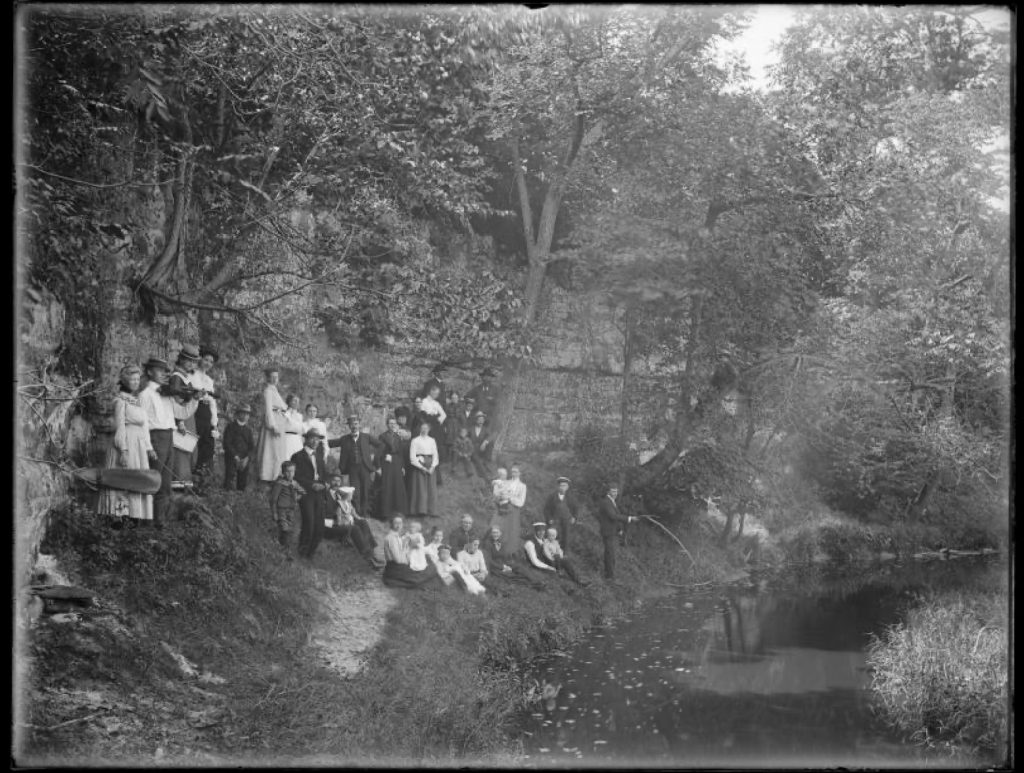
Many things about the landscape of Heath Creek have changed since this photo, namely with secondary growth plants from the seed bank germinating and growing. Recent restorations include seeding of native prairie species, but the plan is for these to eventually be shaded out. In the future, Heath Creek may become more of an oak savannah or open woodland over what it is today.
Despite a commitment to retaining the naturally occurring species in Heath Creek, some native species have had to be replaced in recent restoration efforts. Ash trees have been deeply affected by emerald ash borer, an invasive beetle, making replacing them with more resilient species a more informed and effective choice. Ash trees are being replaced by Sycamore and Kentucky Coffee trees in order for restorations to be more resilient in the long run. Additionally, significant efforts have had to be made in order to push back invasive species such as buckthorn, which dominated the Heath Creek landscape before restoration efforts began.


While Norway Valley is pretty much static in its restoration efforts, a new portion of Heath Creek is currently being restored. A new piece of land, across the creek, was recently acquired by the college and was seeded with native prairie seed. The future plan for this location is to not have trails but instead serve as a restored piece of land that can be only for the ecological community members that live there.
Both Norway Valley and Heath Creek can serve as overwhelmingly positive reminders that original ecosystems find a way to break through. What we may think of as completely empty land may have some species in the seed bank, waiting for an opportunity to peek their way out into the new open spaces.
Sources
https://contentdm.carleton.edu/digital/collection/SJLC/id/103
https://storymaps.arcgis.com/stories/43416fd63b46443eb3f83895dcdccd11
https://wp.stolaf.edu/naturallands/visitor-information-and-rules/history-of-the-natural-lands/
https://www.dnr.state.mn.us/ecs/222Mb/index.html
https://www.dnr.state.mn.us/rys/pg/floodplainforest.html
https://apps.lib.umn.edu/mhapo
https://digital.stolaf.edu/archives/asset/viewAsset/5ef4c36029b2665c7e0bb153
https://www.first-nature.com/fungi/ganoderma-applanatum.php
https://www.mushroom-appreciation.com/mossy-maze-polypore.html
You must be logged in to post a comment.