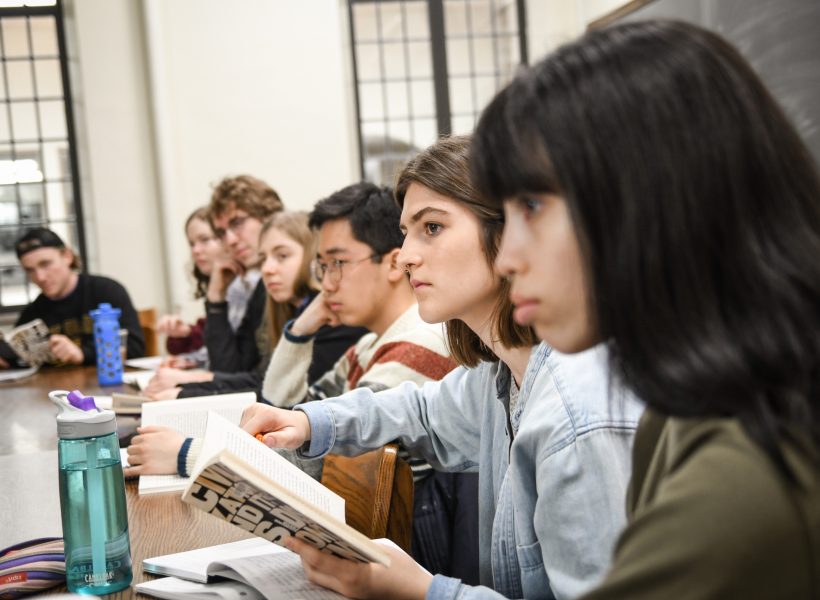
QUEST 113: Heroes, Gods, and Monsters
First Year, Fall Semester
In this First-Year Seminar, students explore the ancient Mediterranean and Asia via sacred texts, heroic and dramatic poems, and philosophical treatises. This course emphasizes close critical analysis, inclusive discussion, and learning in community, as students ask: “How do the philosophy, arts, literature, and religion of various traditions edify our lives?” Through this engagement, students reflect on the purpose of the liberal arts and their positions as modern students of ancient texts.
Key texts/authors (can vary): the Epic of Gilgamesh, Homer, Plato, Aristotle, Sappho, Sophocles, Euripides, the Hebrew Bible, and the Book of Songs, the Zuo Tradition, Mencius
Ole Core: First-Year Seminar (FYS)
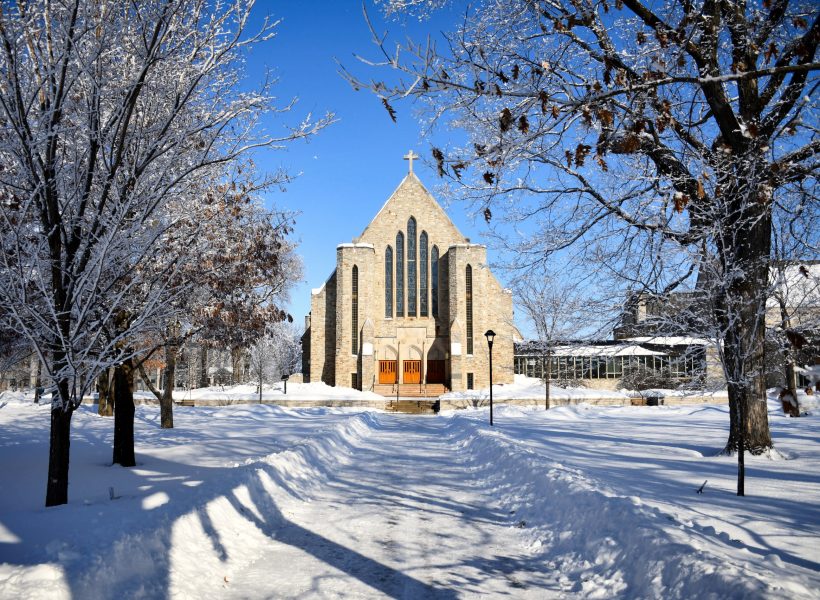
QUEST 115: Emperors, Orators, Disciples
First Year, January Term
In this second course of Enduring Questions, students delve further into the relationships between religion and power that emerged in the Roman and Chinese empires. Students engage with historiography, oratory, epic poetry, philosophical and religious texts, and practice oral communications skills to explore questions such as “What is history?” “How does the past relate to the present?” “How does change happen?” and “What constitutes a good life?”
Key texts/authors (can vary): historiography and oratory, Aeneid and Metamorphoses, West and East philosophy, canonical and non-canonical gospels
Ole Core: Religion, Faith, and Values (RFV)
QUEST 116: Warriors, Mystics, Reformers
First Year, Spring Semester
This writing-intensive course continues the intellectual odyssey of Enduring Questions into the medieval and early modern West, Middle East, and East, as students delve into the legacies of warriors, pilgrims, mystics, and reformers. Students engage with courtly cultures, honor, and romance, as well as travelogues and encounters with what is perceived as strange and foreign, pondering: “Who has access to transcendence?” and “How does the imagination contribute to the search for truth and happiness?”
Key texts/authors (can vary): the Qur’an, Christian and Muslim theology, mysticism; authors like Augustine, Dante, Chaucer, Rumi, Marco Polo, Basho; and texts like Beowulf, Hayy Ibn Yaqzan, Journey to the West
Ole Core: Writing and Rhetoric (WRR)
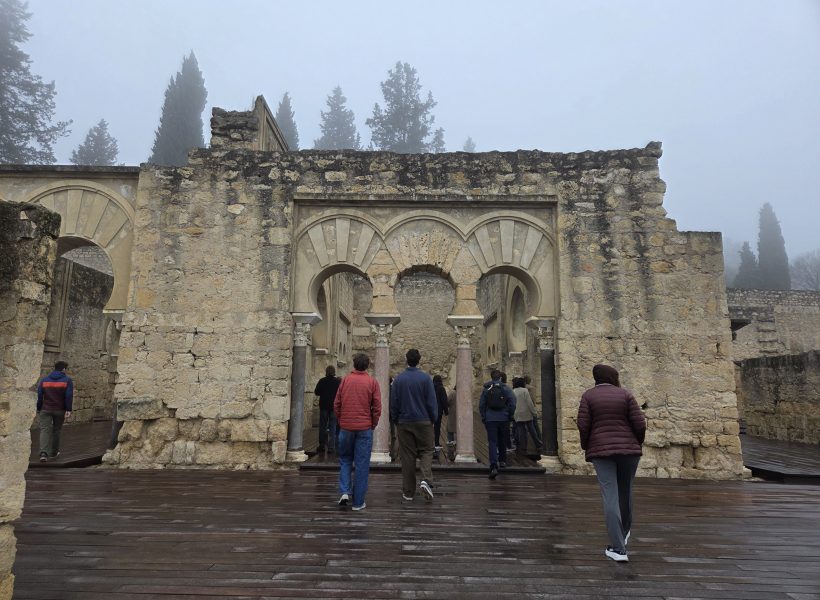
Image: Madinat al-Zahra ruins, near Cordoba, 1/9/2026
QUEST 217: Explorers, Rationalists, Revolutionaries
Second Year, Fall Semester
Students trace the emergence of ideas about humanity, race, knowledge, freedom, power, and myth across the globe between 1600 and 1900, as authors, artists, and revolutionaries contested these concepts. Ideas that promised freedom and universal humanity also justified empire, slavery, and colonization. The course confronts this paradox and asks how its legacies continue to shape our world. Beyond textual close reading, students add their voices through student-led discussions, guest plenaries, and a creative Revolutionary Showcase.
Key texts/authors (can vary): Shakespeare, Descartes, Milton, Sor Juana, Kant, Equiano, Wollstonecraft, Hegel, Marx, Dream of the Red Chamber, Gogol, Anna Cooper
Ole Core: Global History (GHS); Writing Across the Curriculum (WAC)
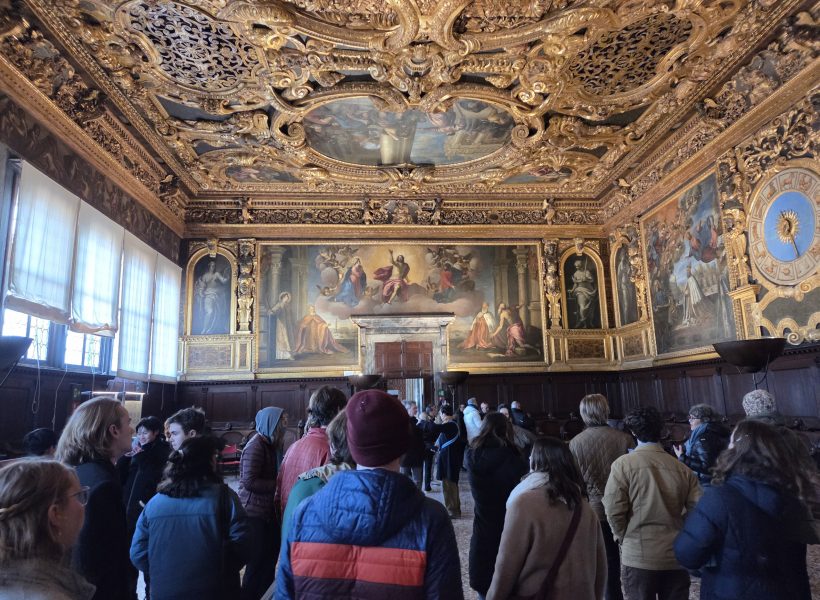
Image: Doge’s palace, Venice, 1/12/2026

QUEST 218: Critics, Dreamers, Radicals
Second Year, Spring Semester
In this course, students consider the twentieth and twenty-first centuries in light of their Enduring Questions experience. Topics include the decline of colonialism, the rise of nationalism, globalization, migration, and the persistence of racism. Engaging with modern and postmodern texts, students identify and evaluate their own creative and ethical views in relation to literary, aesthetic, and moral theories encountered throughout the Enduring Questions program, and reflect broadly on their learning over five consecutive courses.
Key texts/authors (can vary): Freud, Picasso, Woolf, Arendt, Borges, Ibsen, Kawabata, Zora Neale Horton, Lu Xun, Hannah Arendt, Baldwin, Fanon, Audre Lorde
Ole Core: Creativity (CRE); Ethical Reasoning in Context (ERC)
Image: First Synthesis Showcase, 5/15/2024
QUEST 282: What is Europe? Metageography in Vienna and Seville
January Term 2026 (optional study-abroad)
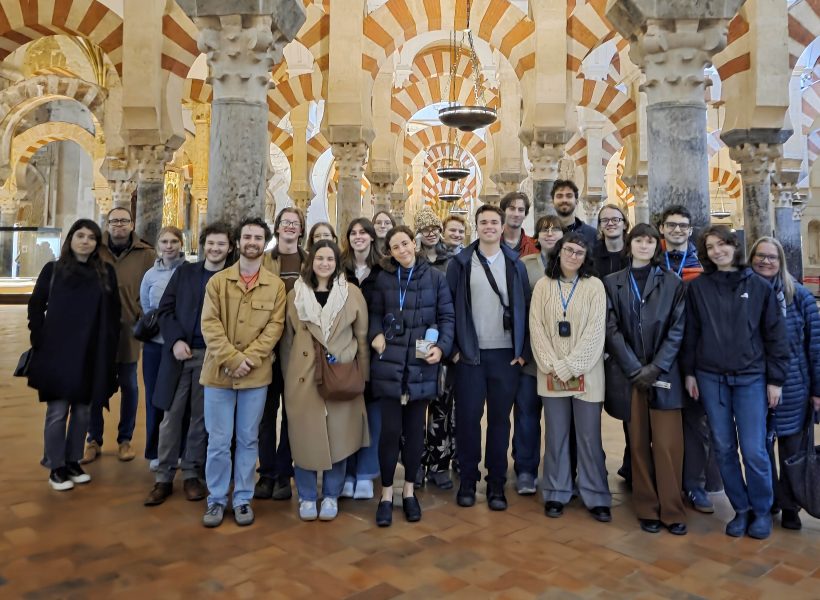
The course explores constructions of Europe and European identity through the approach of metageography, critically examining the arbitrary, contested, power-laden, yet taken-for-granted spatial frameworks through which knowledge is organized. To unpack the notion of “Europe,” students engage with the narratives offered by museums and historic sites in and around Vienna, Austria and Seville, Spain, two cities that have served as political, economic and cultural centers of Europe. Founded as an outpost of the Roman Empire, Vienna became capital of the Holy Roman Empire and of the Austro-Hungarian Empire. It was capital of a neutral nation situated between Cold War blocs and is now a seat of the United Nations. In ancient myth, Seville was founded by the hero Hercules. Colonized by the Phoenicians and the Romans, it was later a capital of the Umayyad Caliphate and then of the Spanish Empire following colonization of the Americas. Today, it is the capital of Andalucía.
Image: Mosque–Cathedral of Cordoba, 1/9/2026