We encourage all Spanish students to study off campus in the U.S., Latin America, or Spain to experience Spanish-speaking cultures firsthand. Here is an overview of opportunities available through St. Olaf.
Three Kinds of Programs
St. Olaf faculty-led J-Terms count the same as a course on campus and are not part of the 2-course limit for study abroad credits in the Spanish Major.
Puerto Rico: SPAN 240 (may be eligible for major credit with prior approval)

This academic civic engagement course explores the culture of Puerto Rico, including its politics, national identity, folklore, and the environment. Students will travel to Puerto Rico (a territory of the U.S.A.), where they will read and analyze authentic materials in Spanish, participate in talks and discussions with local professors, college students and community leaders. Facebook page link here.
- Prerequisites: SPAN 232 or SPAN 233 or placement into SPAN 250 or SPAN 251
- A completed Spanish 250 or 251 course is required in order to be eligible to request major credit in Spanish (through petition).
- Students that have completed more than one 270 course are not eligible to request major credit in Spanish.
Spain: SPAN 270 (counts for the Spanish Major)
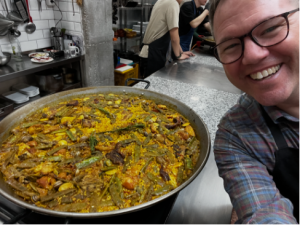
From tourists to Spaniards, many people associate “Spanish” cuisine with stereotypical, iconic dishes like paella. As you might expect with stereotypes, the reality is far more complex. How do ingredients like rice, saffron, and tomatoes–plants native to Eastern Asia, Southwest Asia, and South America, respectively–become key components of what many consider to be Spain’s national dish?
In this course, we will take an in-depth look at the multiple culinary influences and traditions that have shaped Spain’s complex cultural heritage. Through this lens, we will consider the influences of human migration on agricultural practices, of religious identity on eating habits, of climate and globalization on commercial agricultural production. More specifically, we will engage with topics that include Roman farming techniques; the arrival of Muslim rulers in the Iberian Peninsula along with new irrigation methods and new crops; the culinary culture and influence of Sephardic Jewish communities; the arrival of Spaniards in the Americas and the revolutionary changes in European eating habits and colonial exploitation that result; contemporary Spain’s Mediterranean coast as the “orchard of Europe;” immigration; and climate change. Analysis of selected historical, literary, and cultural texts will be supplemented by guest lectures, site visits to museums, cultural institutions, artistic monuments, and cultural observation and field research activities. Course overview.
- Prerequisite: SPAN 250 or SPAN 251
CIEE Program in Seville, Spain
“Living with a host family and teaching English to local students have been super helpful for improving my Spanish. My favorite part about CIEE Seville, though, are the daytrips to different cities where I can experience new places with the friends I’ve made here.” —Lincoln Bramwell ’27
IES Program in Buenos Aires, Argentina
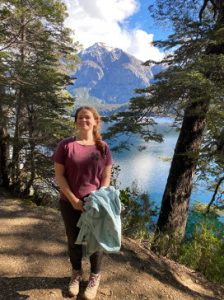
“IES abroad in Buenos Aires has been a really great experience! The staff is very welcoming, and so is the city of Buenos Aires which we can endlessly explore. Buenos Aires’ location allows for easy traveling within Argentina, and South America as a whole, during my time here I’ve visited Rosario, Iguazu, Mendoza, San Rafael, Tigre, Tierra del Fuego and Patagonia (on a school trip). In our classes we learn a lot about South American culture, including often under taught subjects. I would definitely go again!” —Vera Berglund ’27
SIT México (Oaxaca): Migration, Borders, and Transnational Communities
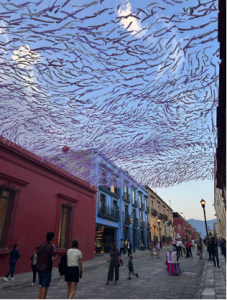
“During my time in Oaxaca, I had the opportunity to explore different places and learn many new things. Meeting new people was one of the best parts, I got to share my experiences while also listening to others talk about their culture and learning from their communities. The most impactful part of the program was my host family; they helped me adjust to their home and welcomed me with open arms. This study abroad program was the best choice I could have made.” —Fatima Mena Salcedo ’27
“During my time on the IFSA Mérida study abroad program, I had the opportunity to take classes both at a university in the city, UADY (la Universidad Autónoma de Yucatán), and through the IFSA program. All of my classes were in Spanish, and I lived with a host family who only spoke Spanish, but they were very kind and invited me right into their family! One highlight for me was traveling with my friends from the IFSA program, including to Mexico City and the state of Chiapas, the coast of the Yucatán Peninsula, and small towns and historical sights around Mérida, like Chichén Itzá.” —Sylvia Sandhorst ’27
USAC Costa Rica (Heredia)
This program is new and just approved! No one has gone on this program yet, but there are good options for Spanish Major credit.
Know Before You Go!
- Check the general guidelines for major-level credit in the drop down on the right.
- You can get 270-level elective credits for the Spanish Major from study abroad, but none of the required courses (SPAN 275 and 276, for example) or 300-level electives can be fulfilled through study abroad.
- Check the general guidelines for major-level credit on this webpage.
- For up-to-date information, learn more by searching the programs on the Smith Center website.
- Check with the Smith Center about courses from these programs that fulfill OLE Core requirements.
- Count a maximum of 2 courses from semester-length off-campus study for the Spanish Major.
- Courses count as 270-level electives (you need 3 of these for the major).
- St. Olaf faculty-led J-Terms do not count against this maximum—you can do both!
- Plan ahead! the Spanish major requires 5 elective credits total, two must be 300-level courses taken at St. Olaf.
- if you plan to bring 2 courses for the major from study abroad, you will need at least 2 300-level courses and 1 additional 270- or 300-level elective through St. Olaf.
- Talk with a faculty advisor in the Spanish Program to get pre-approval for courses you want to count for the Spanish major!
- Are you also a Latin American Studies major? In addition, some courses offered in these programs may count toward the Latin American Studies major. The Director of Latin American Studies can advise you with regard to applying courses from these programs to that major.
General Guidelines for Major-Level Credit for Spanish from Off-Campus Study (approved 2026)
Note: The following list is a set of general guidelines used by Spanish faculty in determining which off-campus courses are appropriate for major-level credit, determined by the procedures that follow.
- Courses, research, or extended projects that would contribute credit towards the Spanish major must be conducted primarily in Spanish.
- Credit will only be awarded for courses/credit-bearing experiences that are faculty led or mentored and credit-bearing.
- The level of language, reflection, and analysis should meet or exceed the criteria for Spanish 250/251 on campus.
- The course/credit-bearing experience should include reading, writing, or experiential learning, commensurate with on-campus Spanish major courses. Generic conversation courses will not count.
- Students may count up to two courses/credit-bearing experiences as 270-level electives for the Spanish major.
- Provided they are approved by the Spanish faculty according to the categories below, the courses/credit-bearing experiences may include up to two courses on language, literature, or culture of the Spanish-speaking world, or a combination with up to one “applied Spanish” credit-bearing experience on a topic of interest to the student. [Examples: a psychology course taken in Spanish or an extended research project conducted through Spanish in an immersive context]
- These guidelines will be shared with the Smith Center and program advisors for the purpose of sharing with students going on programs in the Spanish-speaking world.
Procedures for Spanish Major Credit from Semester-Length Off Campus Study
- We will continue to pre-approve appropriate courses in semester-length programs that directly serve the Spanish program by offering language, literature, and culture focused courses in Spanish at a language and content level equivalent to Spanish 250/251 or above.
- Not all courses offered through St. Olaf-approved programs are pre-approved for Spanish-major credit. Students must seek guidance from a faculty adviser in Spanish prior to departure and during registration in order to select courses appropriate for counting towards the Spanish major. Students or the Smith Center should provide copies of syllabi for potential courses for conditional approval. Conditional approval of this kind will guarantee that the courses in question count towards the Spanish major for that student but not necessarily for future students. Not doing this may jeopardize the student’s ability to count off-campus courses for the major.
- While studying off campus, students should keep copies of assignments of conditionally approved courses for the Spanish major in order to share with Spanish faculty when they return for approval for future students.
- For courses from non-St. Olaf approved programs, students will need to petition to have those courses count for the Spanish major and should consult with a faculty adviser in the Spanish program beforehand and keep all assignments for the petition process after their return.
FAQ’s
- Generally St. Olaf courses numbered below 250/251 do not count for the major.
- With advance planning, SPAN 240 in Puerto Rico can count for the major through assignments that raise the level of the course in consultation with the instructor. Note that a completed Spanish 250 or 251 course is required in order to be eligible to request major credit in Spanish (through petition), and students that have completed more than one 270 course are not eligible.
- Courses from non-St. Olaf faculty led semester programs must be equivalent in content and language to at least SPAN 250/251 at St. Olaf. Consult with a Spanish faculty advisor (the Smith Center can help obtain syllabus copies if necessary).
- Use the guidelines on this webpage to help plan options.
- Meet with a faculty advisor in the St. Olaf Spanish Program before you go.
- Email a faculty advisor in the St. Olaf Spanish Program once you’re there and preparing to register for classes.
- After the program, it may take some time for your credits to show up in DegreePath.
- Once the credits show up, check to see if they have been counted for the Spanish Major in DegreePath (some that have counted in prior semesters may get added automatically).
- If your credits have not automatically been counted for the Spanish Major, reach out to the Department Chair of Romance Languages (or Section Head of Spanish if the chair is in French) to have these credits added to the major