Exposure Control Plan
Category: Environmental Health & Safety
Last updated: 03/29/2023
Statement
The Bloodborne Pathogens (BBP) Program for St. Olaf College is designed to comply with the OSHA Bloodborne Pathogens Standard (29 CFR 1910.1030). The program aims to protect faculty, staff, and students from occupational exposure to human blood, blood components, and other potentially infectious materials (OPIM).
Purpose
Audience
Definitions
Acronyms found in this written plan:
CDC: Centers for Disease Control and Prevention
CHO: Chemical Hygiene Officer
ECP: Exposure Control Plan
ERTK: Employee Right To Know Act
HBV: Hepatitis B Virus
HIV: Human Immunodeficiency Virus
NIH: National Institutes of Health
NIOSH: National Institute for Occupational Safety and Health
OPIM: Other potentially infectious material (see Section 3.2(b) for details)
OSHA: Occupational Safety and Health Administration
PPE: Personal Protective Equipment
RNS: Regents Hall of Natural Sciences
SAC: Skoglund Athletic Center
Blood. Human blood, human blood components, and products made from human blood.
Bloodborne Pathogens (BBP). Pathogenic microorganisms that are present in human blood and can cause disease in humans. These pathogens include, but are not limited to, Hepatitis B virus (HBV) and human immunodeficiency virus (HIV).
Contaminated. The presence or the reasonably anticipated presence of blood or other potentially infectious materials on an item or surface.
ontaminated Laundry. Laundry that has been soiled with blood or other potentially infectious materials, or may contain sharps.
Contaminated Sharps. Any contaminated object that can penetrate the skin including but not limited to: needles, scalpels, broken glass, broken capillary tubes, and exposed ends of dental wires.
Decontamination. The use of physical (e.g., autoclave) or chemical means to remove, inactivate, or destroy bloodborne pathogens on a surface or item to the point where they are no longer capable of transmitting infectious particles and the surface or item is rendered safe for handling, use, or disposal.
Engineering Controls. Controls (e.g., sharps disposal containers, self-sheathing needles, needleless systems) that isolate or remove the bloodborne pathogens hazard from the workplace.
Exposure Incident. A specific eye, mouth, other mucous membrane, non-intact skin, or parenteral contact with blood or other potentially infectious materials that results from the performance of an employee’s duties.
Non-Intact Skin. Areas of the skin that have been opened by cuts, abrasions, dermatitis, chapped skin, etc.
Occupational Exposure. Reasonably anticipated skin, eye, mucous membrane, or parenteral contact with blood or other potentially infectious materials that may result from the performance of an employee’s duties.
OSHA 300 Log. Logbook of work-related injuries and illnesses.
Other Potentially Infectious Material (OPIM). Includes the following:
- The following human body fluids: semen, vaginal secretions, cerebrospinal fluid, synovial fluid, pleural fluid, pericardial fluid, amniotic fluid, saliva in dental procedures, any body fluid that is visibly contaminated with blood, and all fluids in situations where it is difficult or impossible to differentiate between
- Any unfixed tissue or organ (other than intact skin) from a human (living or dead).
- HIV-containing cell or tissue cultures, organ cultures, and HIV- or HBV-containing culture medium or other solutions; and blood, organs or other tissues from experimental animals infected with HIV or
Parenteral. Piercing of mucous membranes or the skin barrier through such events as needlesticks, human bites, cuts, and abrasions.
Regulated Waste. Liquid or semi-liquid blood or other potentially infectious materials; contaminated items that would release blood or other potentially infectious materials in a liquid or semi-liquid state if compressed; items that are caked with dried blood or other potentially infectious materials and are capable of releasing these materials during handling; contaminated sharps; and pathological and microbiological wastes containing blood or other potentially infectious materials.
Routinely Exposed. “Routinely exposed” means a reasonable potential for exposure exists during the normal course of assigned work. It includes the exposure of an employee to a hazardous substance when assigned to work in an area where a hazardous substance has been spilled. It does not include a simple walk-through of an area where a hazardous substance, harmful physical agent, or infectious agent is present or an assignment to work in an area where a container of a hazardous substance is present but there is no actual exposure unless a spill should occur.
Source Individual. Any individual, living or dead, whose blood or other potentially infectious materials may be a source of occupational exposure to the employee.
Work Practice Controls. Controls that reduce the likelihood of exposure by altering the manner in which a task is performed (e.g., prohibiting recapping of needles by a two-handed technique).
Universal Precautions. An approach to infection control. All human blood and certain human body fluids are treated as if known to be infectious for HIV, HBV, and other bloodborne pathogens.
Policy
- Introduction
- Statement of Policy
- Scope and Application
- Definitions
- Responsibilities (Program Administration)
- Employee Exposure Determination
- Methods of Implementation and Control
- Program Evaluation and Annual Review 6 Work Practice Controls
- Universal Precautions 7 Housekeeping
- Labels 8 Cleanup of Blood or Other Bodily Fluids
- Engineering Controls 9 Contaminated Laundry
- PPE, and Hazard Assessment/PPE Selection 10 Regulated Waste Collection and Disposal
- Hepatitis B Vaccination
- Post-Exposure: First Aid, Medical Evaluation and Follow-Up
- Post-Exposure: Administration of Medical Evaluation and Follow-Up
- Post-Exposure: Incident Investigation and Corrective Actions
- Post-Exposure: OSHA 300 Log; Sharps Injury Log
- Employee Training
- Record Keeping
- Program Evaluation
- Revision Record
- References
Appendix A: ECP Annual Review Implementation Form
Appendix B: Hazard Assessment / PPE Selection
Appendix C: Hepatitis Forms
Appendix D: BBP Exposure Incident Report
Appendix E Sharps Injury Log
Appendix F: Summary of Awareness-Level Training
1 Introduction
In 1983, the Minnesota Legislature passed the Minnesota Employee Right-to-Know (ERTK) Act1, requiring all employers to evaluate their workplaces for the existence of (1) hazardous substances, (2) harmful physical agents, and (3) infectious agents, and to provide training and information to those employees who may be exposed to these substances and agents in the workplace.
As per Minnesota Rules 5206.0600 (Infectious Agents)2, a written Exposure Control Plan (ECP) that meets the requirements of the Occupational Safety and Health Administration (OSHA) Bloodborne Pathogen Standard 29 CFR 1910.10303 (and the 2001 revision to comply with the Needlestick Safety and Prevention Act4) and covers all infectious agents to which employees may be exposed in the workplace also meets the ERTK requirements for infectious agents.
OSHA enacted the Bloodborne Pathogen Standard to reduce/eliminate occupational exposure to Hepatitis B virus (HBV), Hepatitis C virus (HCV), Human Immunodeficiency Virus (HIV), and other potentially infectious materials (OPIM) that employees may encounter in their workplaces.
In brief, the St. Olaf College Exposure Control Plan includes:
- Responsibilities/program administration.
- Methods of Implementation and Control.
- Communication of potential hazards to employees.
- Instructions for how employees may receive the Hepatitis B vaccination.
- Determination of employee exposure (if an exposure should occur).
- Procedures for post-exposure evaluation and follow-up (if an exposure should occur).
- Requirements for employee training.
- Instructions for maintaining a sharps injury log.
- Instructions for annual review of new medical devices and procedures.
The following St. Olaf Exposure Control Plan is based on templates provided by the Minnesota Model Exposure Control Plan5,and the OSHA Model Exposure Control Plan6, and has been tailored to fit the needs of St. Olaf. The St. Olaf Employee Exposure Control Plan can be downloaded as a pdf from the ECP webpage7, obtained from the Environmental Health and Safety (EHS) Office, or requested from an employee’s supervisor.
2 Statement of Policy
2.1 Contact Information.
(a) Issuing Authority: Vice President and Chief Financial Officer
(b) Contact: Elisabeth Haase; Department of Environmental Health and Safety; haase2@stolaf.edu; 507-786-2292
(c) Last Updated: 03/29/2023
2.2 St. Olaf College is committed to maintaining a safe and healthy work environment. This written Exposure Control Plan is intended to:
(a) Ensure that all College employees are aware of the dangers associated with exposure to blood or other potentially infectious materials (OPIM).
(b) Eliminate or minimize occupational exposure to bloodborne pathogens (BBP) in accordance with OSHA Bloodborne Pathogen Standard 29 CFR 1910.1030 (“Occupational Exposure to Bloodborne Pathogens”)3.
(c) Ensure that if an exposure or suspected exposure occurs then the employee knows to immediately seek medical attention and also contact their supervisor so that we can begin the proper medical evaluation & follow-up. We also want to promptly initiate an incident investigation so that the same or similar incident does not happen to anyone else.
2.3 Exposure Control Plan. The ECP is a key element to assist St. Olaf College in the protection of College employees. It also assists St. Olaf College in ensuring compliance with ERTK. This ECP includes:
(a) Responsibilities/Program Administration.
(b) Employee Exposure Determination.
(c) Methods of Implementation and Control, including:
- Program Evaluation and Annual Review.
- A Description of Universal Precautions.
- Engineering and Work Practice Controls.
- Personal Protective Equipment (PPE).
- Labels/Hazard Communication.
- Waste Collection and Disposal.
(d) Instructions for how employees may receive the Hepatitis B vaccination.
(e) Determination of employee exposure (if an exposure should occur).
(f) Procedures for post-exposure evaluation and follow-up (if an exposure should occur).
(g) Description how a post-exposure incident investigation will proceed.
(h) Instructions for maintaining a sharps injury log.
(i) Requirements for employee training.
(j) Instructions for annual review of the ECP.
(k) Record Keeping.
2.4 Accessibility of the ECP.
(a) Employees covered by the Bloodborne Pathogens Standard receive an explanation of this ECP during their new employee training session. It is also reviewed during their annual refresher training.
(b) As per Minnesota Rules 5206.0700 Subpart 1.F2, St. Olaf employees have ready access to a variety of internet-connected computers in their work areas so that they can access and read the St. Olaf ECP webpage and the ECP.
(c) Employees can access this website 24/7, every day of the year. If they desire a hard copy of the RPP but cannot access a printer, they may request one from their supervisor or EHS.|
(d) Within 24 hours of receiving the request, excluding non-workdays, the supervisor or EHS will provide a hard copy to the employee.
3 Scope and Application
3.1 St. Olaf Employees.
(a) Those employees identified in Section 6, including part-time and temporary employees, who have an occupational exposure to blood, bloodborne pathogens, or other potentially infectious materials (OPIM) must comply with the procedures and work practices outlined in this ECP.
(b) Department of Nursing personnel. The relationship between the St. Olaf College Nursing Program and various health care settings in which students have clinical experiences (and in which faculty also provide supervision) is both professional and legal. Contracts are developed with the clinical agencies that include specific stipulations for the protection of patients as well as faculty and staff. As part of its accreditation, the Nursing Program has its own written Faculty Handbook that that includes its own Exposure Control Plan and training. While Nursing personnel are working on campus they do follow the relevant methods of implementation and control (Section 7) from the St. Olaf ECP.
3.2 Infectious Agents.
(a) Bloodborne Pathogens means pathogenic microorganisms that are present in human blood and can cause disease in humans. These pathogens include but are not limited to Hepatitis B virus (HBV), Hepatitis C virus (HCV), and Human Immunodeficiency Virus (HIV).
(b) OPIM (other potentially infectious materials) includes:
- The following human body fluids: semen, vaginal secretions, cerebrospinal fluid, synovial fluid, pleural fluid, pericardial fluid, amniotic fluid, saliva in dental procedures, any body fluid that is visibly contaminated with blood, and all fluids in situations where it is difficult or impossible to differentiate between
- Any unfixed tissue or organ (other than intact skin) from a human (living or dead).
- HIV-containing cell or tissue cultures, organ cultures, and HIV- or HBV-containing culture medium or other solutions; and blood, organs or other tissues from experimental animals infected with HIV or HBV.
3.3 Needlestick or Sharps Injury.
(a) A cut, laceration, puncture, or scratch caused by a clean needle or sharp object (i.e., one that has not come in contact with blood or OPIM) is not a needlestick injury.
(b) If it cannot be determined that the offending needle or sharp object is not contaminated with blood or OPIM, then the injury will be treated as an exposure and all steps in Section 9 will be followed.
3.4 An Exposure is not necessarily an injury.
(a) Exposure to another person’s blood or to OPIM without being cut or punctured does not, in itself, constitute an injury or illness.
(b) If an employee is splashed or exposed to blood or OPIM without being cut or punctured, the incident is recorded in the OSHA 300 Log only if the incident results in the diagnosis of a bloodborne illness or a positive blood test, or it meets one or more of the recording criteria of 29 CFR 1904.7, such as job transfer, work restriction, or days away from work.
3.5 The Exposure Control Plan is based on the following principles:
(a) The risk of exposure to pathogenic agents should never be underestimated.
(b) It is prudent to minimize exposure to all pathogenic organisms.
(c) All laboratory areas should institute as many engineering and work practice controls as possible to eliminate or minimize exposure to pathogenic organisms.
4 Definitions
Acronyms found in this written plan:
- CDC: Centers for Disease Control and Prevention
- CHO: Chemical Hygiene Officer
- ECP: Exposure Control Plan
- ERTK: Employee Right To Know Act
- HBV: Hepatitis B Virus
- HIV: Human Immunodeficiency Virus
- NIH: National Institutes of Health
- NIOSH: National Institute for Occupational Safety and Health
- OPIM: Other potentially infectious material (see Section 3.2(b) for details)
- OSHA: Occupational Safety and Health Administration
- PPE: Personal Protective Equipment
- RNS: Regents Hall of Natural Sciences
- SAC: Skoglund Athletic Center
Blood. Human blood, human blood components, and products made from human blood.
Bloodborne Pathogens (BBP). Pathogenic microorganisms that are present in human blood and can cause disease in humans. These pathogens include, but are not limited to, Hepatitis B virus (HBV) and human immunodeficiency virus (HIV).
Contaminated. The presence or the reasonably anticipated presence of blood or other potentially infectious materials on an item or surface.
Contaminated Laundry. Laundry that has been soiled with blood or other potentially infectious materials, or may contain sharps.
Contaminated Sharps. Any contaminated object that can penetrate the skin including but not limited to: needles, scalpels, broken glass, broken capillary tubes, and exposed ends of dental wires.
Decontamination. The use of physical (e.g., autoclave) or chemical means to remove, inactivate, or destroy bloodborne pathogens on a surface or item to the point where they are no longer capable of transmitting infectious particles and the surface or item is rendered safe for handling, use, or disposal.
Engineering Controls. Controls (e.g., sharps disposal containers, self-sheathing needles, needleless systems) that isolate or remove the bloodborne pathogens hazard from the workplace.
Exposure Incident. A specific eye, mouth, other mucous membrane, non-intact skin, or parenteral contact with blood or other potentially infectious materials that results from the performance of an employee’s duties.
Non-Intact Skin. Areas of the skin that have been opened by cuts, abrasions, dermatitis, chapped skin, etc.
Occupational Exposure. Reasonably anticipated skin, eye, mucous membrane, or parenteral contact with blood or other potentially infectious materials that may result from the performance of an employee’s duties.
OSHA 300 Log. Logbook of work-related injuries and illnesses.
Other Potentially Infectious Material (OPIM). Includes the following:
- The following human body fluids: semen, vaginal secretions, cerebrospinal fluid, synovial fluid, pleural fluid, pericardial fluid, amniotic fluid, saliva in dental procedures, any body fluid that is visibly contaminated with blood, and all fluids in situations where it is difficult or impossible to differentiate between
- Any unfixed tissue or organ (other than intact skin) from a human (living or dead).
- HIV-containing cell or tissue cultures, organ cultures, and HIV- or HBV-containing culture medium or other solutions; and blood, organs or other tissues from experimental animals infected with HIV or
Parenteral. Piercing of mucous membranes or the skin barrier through such events as needlesticks, human bites, cuts, and abrasions.
Regulated Waste. Liquid or semi-liquid blood or other potentially infectious materials; contaminated items that would release blood or other potentially infectious materials in a liquid or semi-liquid state if compressed; items that are caked with dried blood or other potentially infectious materials and are capable of releasing these materials during handling; contaminated sharps; and pathological and microbiological wastes containing blood or other potentially infectious materials.
Routinely Exposed. “Routinely exposed” means a reasonable potential for exposure exists during the normal course of assigned work. It includes the exposure of an employee to a hazardous substance when assigned to work in an area where a hazardous substance has been spilled. It does not include a simple walk-through of an area where a hazardous substance, harmful physical agent, or infectious agent is present or an assignment to work in an area where a container of a hazardous substance is present but there is no actual exposure unless a spill should occur.
Source Individual. Any individual, living or dead, whose blood or other potentially infectious materials may be a source of occupational exposure to the employee.
Work Practice Controls. Controls that reduce the likelihood of exposure by altering the manner in which a task is performed (e.g., prohibiting recapping of needles by a two-handed technique).
Universal Precautions. An approach to infection control. All human blood and certain human body fluids are treated as if known to be infectious for HIV, HBV, and other bloodborne pathogens.
5 Responsibilities (Program Administration)
5.1 Human Resources.
(a) Compile (with input from EHS) the names of all College employees who, because of the nature of their jobs, are included under the ECP.
(b) Work with the EHS Training Coordinator to implement the training matrix/assignment database to ensure that employees are assigned all required and relevant training.
(c) Retain the database of training records.
(d) Be responsible for ensuring that all employee medical actions required are performed and that appropriate employee health and OSHA records are maintained, such as:
(1) Ensure that health care professional(s) responsible for employee’s Hepatitis B vaccination and any post-exposure evaluation and follow-up are given a copy of OSHA’s Bloodborne Pathogens Standard3.
(2) Maintain the Sharps Injury Log (Appendix E).
(e) Ensure that all ECP post-exposure requirements (sections 9-12) are conducted in a timely manner.
5.2 Environmental Health and Safety (ECP Coordination)
(a) The EHS Director is the ECP Coordinator and has overall responsibility for the ECP.
(b) The Chemical Hygiene Officer (CHO) will:
(1) Maintain, review, and update the ECP no less than once each year, and whenever necessary, to include new or modified tasks and procedures or to reflect new or revised employee positions with occupational exposure; update the ECP website accordingly.
(2) Ensure that employees are aware of any potentially infectious agents that might be housed within laboratories, and that employees are following all laboratory biosafety protocols.
(3) Serve as the Biosafety Officer and oversee NIH/CDC compliance with laboratory activities involving OPIM.
(4) Assist the EHS Training Coordinator in providing BBP training as needed.
(c) The EHS Training Coordinator oversees the ECP Training Program and will:
- Provide initial, annual, and (as needed) refresher BBP training, including proper selection, use, and disposal of personal protective equipment (PPE).
- Work with HR to ensure documentation of training.
5.3 Department Directors, Supervisors, and Managers.
Primary responsibility for ensuring that St. Olaf employees follow the appropriate ECP safety guidelines falls to the various directors, managers, and supervisors who promote, encourage, and exemplify a culture of safety for their employees to emulate during everyday work activities. These leaders shall:
(a) Work with EHS and HR to identify personnel with a potential for occupational exposure to bloodborne pathogens or other potentially infectious materials; alert EHS whenever an employee is assigned new duties that may result in possible exposure, and hence require new/additional training.
(b) Ensure that the Hepatitis B vaccination forms (see Section 8) are presented to the employee within the first ten days of initial assignment. Use departmental funds to pay for Hepatitis B vaccinations for their employees who have occupational exposure.
(c) Ensure that employees complete required training sessions (see Section 13.2) and understand how to access the ECP webpage7.
(d) Ensure that covered employees follow universal precautions and comply with the requirements outlined in this ECP for safe work practices, sharps injury reporting, and follow-up.
(e) Serve as the Personal Protective Equipment Coordinators. Maintain and provide all necessary personal protective equipment, engineering controls (e.g., sharps containers), labels, and red bags as required by the standard, and ensure that adequate supplies of the aforementioned equipment are available in the appropriate sizes.
(f) Contact EHS for technical support when questions arise regarding compliance and safe procedures.
(g) Periodically evaluate the effectiveness of the ECP as it applies to the work that their affected employees perform, and provide EHS with conclusions, compliance challengers, and recommendations for improvement.
(h) Work with EHS and HR to help gather relevant information should an exposure occur (see Sections 9-12).
5.4 Employees.
(a) Immediately contact their supervisor if they suspect an exposure (either via a sharp/needle stick, or by a splash/other contact). We want to administer first aid, and post-exposure evaluation & follow-up as effectively as possible.
(b) Conduct all tasks in accordance with the rules and guidelines set forth in the ECP and their work area SOPs. This includes inspecting all PPE for defects before use, and practicing good personal hygiene habits.
(c) Complete ECP training upon initial assignment, during annual refresher, or as necessary.
(d) Ensure that they understand potential exposure from work tasks, and the potential routes of exposure.
(e) Proactively notify their supervisor when questions arise surrounding safe procedures, the need for or concerns about safety equipment, and difficulties complying with these requirements.
6 Employee Exposure Determination (this determination is made without regard to the use of PPE)
6.1 List of job classifications in which ALL employees have occupational exposure. In these jobs the normal work routine involves administering first aid and other health care, or handling items that may be contaminated with blood and other bodily fluids. Included is a list of tasks and procedures, or groups of closely related tasks and procedures, in which occupational exposure may occur.
| Job Title | Department/Location | Task/Procedure |
| Athletic Trainer | Athletics | First aid; working with injuries; changing dressings; cleanup of bodily fluids; CPR. |
| Athletic Coaches | Athletics | First aid; working with injuries; cleanup of bodily fluids; CPR. |
| Athletic Support Staff | Athletics | Contaminated laundry; cleaning athletic equipment. |
| Intramurals/Recreation Staff | Athletics | First aid; working with injuries; cleanup of bodily fluids; contaminated laundry; cleaning athletic equipment. |
| Public Safety Personnel | Public Safety | First aid; working with injuries; cleanup of bodily fluids; CPR. |
| Custodial Services | Facilities | Cleanup of bodily fluids; handling regulated waste containers. |
6.2 List of job classifications in which SOME employees have occupational exposure. In these jobs the normal work routine does not involve exposure to blood, bodily fluids, or tissues; however, given the employee’s work duties, exposure or potential exposure may occur during the course of the workday. Included is a list of tasks and procedures, or groups of closely related tasks and procedures, in which occupational exposure may occur.
| Job Title | Department/Location | Task/Procedure |
| EHS Personnel | EHS | First aid; cleanup of bodily fluids; handling regulated waste containers. |
| Building Services | Facilities | Cleanup of bodily fluids; handling regulated waste containers. |
| Engineering Services | Facilities | Cleanup of bodily fluids; handling regulated waste containers. |
| Grounds Services | Facilities | Cleanup of bodily fluids; handling regulated waste containers. |
| Nursing Faculty | Regents Hall of Natural Sciences (RNS) | First aid; cleanup of bodily fluids; handling regulated waste containers. |
| Laboratory Stockroom Managers; Faculty | Regents Hall of Natural Sciences (RNS) | First aid; cleanup of bodily fluids; handling regulated waste containers. |
| Art, Dance, and Theater Technicians; Faculty | Center for Art and Dance; Theater Building | First aid; cleanup of bodily fluids; handling regulated waste containers. |
7 Methods of Implementation and Control
The following methods of compliance are implemented to ensure that every employee covered by the Bloodborne Pathogens Standard has an understanding of how to control exposure.
7.1 Program Evaluation and Annual Review.
(a) Program Evaluation. One of the most important aspects of the ECP is that it is forever evolving. This is not intended to be a static program. Every time an exposure occurs, the circumstance is evaluated to determine how it could have been avoided. Therefore, the plan, policies, and worker safety are improved by learning from errors.
(b) Annual Review. The ECP will undergo a review no less than once each year, and whenever necessary, to assess the need for changes in the plan, engineering controls, and/or work practices. This review is also designed to identify advances in safer engineering controls. A thorough review may include an evaluation of the cause of past incidents, OSHA records, employee interviews, committee activities, literature review, etc.
(c) Annual Review Implementation Form. This form is attached as Appendix A.
7.2 Universal Precautions.
(a) Since there is no way to know the status of bodily fluids from an unknown source, all human blood and OPIM must be treated as if known to be infectious for HIV, HBV, or other bloodborne pathogens.
(b) Follow this mantra: “If it’s wet, and it’s not yours, then don’t get it on you!”
(c) Gloves will be worn at all times when handling items, cleaning equipment or cleaning up spills, containerizing, or transporting containers (Section 7.6(g)).
(d) Additional appropriate PPE such as goggles, face mask, and impervious outer clothing is used if splattering is possible.
(e) Employees shall wash hands immediately after completing the task, in accordance with the hand washing work practices described in Section 7.6(h).
(f) Dispose of regulated waste only in approved labeled/color-coded biohazard bags or sharps containers (Section 7.10).
7.3 Labels.
(a) All equipment and containers used to manipulate, store, or transport infectious materials must be labeled with the universal “Biohazard” symbol. This label may also contain the wording “Infectious Waste” or “Biohazard.” The label must be orange or red-orange, with the biohazard symbol and wording in a contrasting color.
(b) Regulated waste is collected in either sharps containers or in color-coded impervious bags (i.e., “red bags”).
(c) Supervisors will ensure that warning labels are affixed, or red bags are used as required, if contaminated waste or equipment is handled.
(d) If no label is present. Employees must notify their supervisors as soon as regulated waste, refrigerators containing blood or OPIM, or contaminated equipment is discovered without appropriate biohazard labels.
7.4 Engineering Controls.
(a) Engineering Controls isolate or remove the BBP hazard from the workplace. Engineering Controls:
(1) Include items such as hand washing sinks and eyewash facilities, biosafety cabinets, sharps containers, self-sheathing needles, safer medical devices such as sharps with engineered injury protections, and needleless systems.
(2) Shall be examined and maintained or replaced on a regular schedule to ensure their effectiveness.
(3) Are used whenever possible to eliminate or minimize employee exposure to bloodborne pathogens.
(4) Are reviewed annually for the availability of safer medical devices; the review is documented, and input is provided by non-administrative staff.
(b) Non-Sharps Containers (i.e., biohazard or “red” bags) are specifically designed to be leak-proof, color-coded or labeled with a biohazard warning label, and capable of being securely closed.
(c) Sharps Containers are available in restrooms across campus for personal use; within the SAC 22B suite; and throughout RNS laboratories for research and teaching activities. They are: puncture-resistant; color-coded or labeled with a biohazard warning label; leak-proof on the sides and bottom; and capable of being securely closed.
(1) Sharps containers in the restrooms are monitored and replaced by the Custodial staff; full containers are brought to SAC 22B for temporary storage until the next scheduled waste disposal.
(2) Sharps containers used in the RNS laboratories are monitored and replaced by the RNS Stockroom Managers and CHO. These containers do not contain infectious materials but rather are used to safely collect and dispose of needles, syringes, etc. that are used for various lab teaching and research procedures.
(3) Sharps containers in SAC 22B are monitored and replaced by the Athletic Trainers.
7.5 Personal Protective Equipment (PPE), and Hazard Assessment/PPE Selection.
(a) St. Olaf College provides appropriate PPE to its employees at no cost, and will ensure that all appropriate sizes are available.
(b) Supervisors will ensure that PPE is available to their employees throughout the entire workshift.
(c) Training on the appropriate use of PPE is provided by the employee’s supervisor in consultation with the EHS Training Coordinator or the CHO.
(d) The following types of PPE are available from supervisors:
(1) Gloves.
(a) Disposable single-use nitrile gloves (available in a range of sizes).
(b) Utility gloves that are worn over disposable gloves. These may be decontaminated for reuse if they show no signs of cracking, peeling, tearing, puncturing, or deterioration.
(2) Goggles. Chemical splash-resistant goggles.(
3) Additional PPE that is also available (if necessary) includes disposable impermeable gowns/lab coats; face shields; medical masks; shoe covers; mouth pieces and resuscitation bags (for CPR).
(e) Hazard Assessment/PPE Selection. OSHA requires employers to assess the work environment to determine if hazards are present which necessitate the use of PPE. EHS will work with supervisors to ensure the following;
(1) A hazard assessment is accomplished to identify potential hazards.
(2) The hazard-appropriate, and properly fitted, PPE is provided to the employee. PPE selection decisions and criteria will be communicated to the employee.
(3) Employees are trained on PPE usage: when it is required, its limitations, and how to use it.
(4) The Hazard Assessment/PPE Selection and Certification Form can be found in Appendix B.
7.6 Work Practice Controls.
(a) Work Practice Controls are used to prevent or minimize exposure to bloodborne pathogens.
(b) Laboratory personnel will also follow all protocols outlined in the Biosafety section of the Laboratory Safety Manual8.
(c) Eating, drinking, smoking, applying cosmetics or lip balm, and handling contact lenses is prohibited in work areas where there is potential for exposure to BBP.
(d) All procedures shall be performed as to minimize splashing, spraying, spattering, or other actions that can generate droplets/aerosols.
(e) All employees using PPE are required to observe the following precautions:
(1) Prior to use inspect all PPE for defects. If there are any suspected defects then immediately inform your supervisor, and dispose of the item so that it can not be used accidentally by others.
(2) If there is a hazard of aerosols, splashes, splatters, sprays, or droplets of blood or OPIM then chemical splash goggles and a medical face mask shall be worn (see Section 7.6(f)).
(3) If PPE becomes contaminated by blood or OPIM remove it immediately or as soon as feasible in such a way as to avoid contact with the outer (contaminated) surface.
(4) Remove used PPE before leaving the work area.
(5) Place used PPE in the appropriate containers in your work area for disposal, washing, decontamination, or storage (see Sections 7.9 & 7.10).
(6) Wash your hands immediately or as soon as feasible after removal of gloves or other PPE (see Section 7.6(h)).
(f) Donning (Putting On) and Doffing (Taking Off) PPE: follow this illustrated CDC guide9 to ensure the proper sequence of applying and removing PPE. To remove contaminated gloves follow the illustrated instructions10 found on the EHS BBP website7.
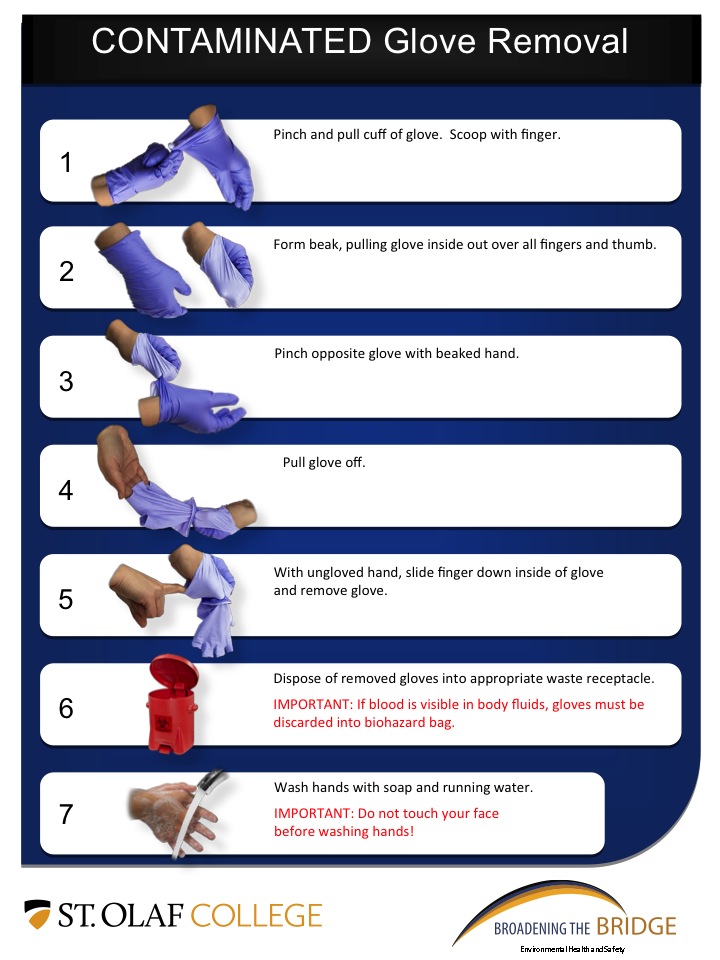
(g) Proper Glove Use.
(1) Gloves must be worn when it can be reasonably anticipated that there may be hand contact with blood, OPIM, or contaminated items/surfaces.
(2) After putting gloves on, reinspect for damage.
(3) Replace gloves if torn, punctured, contaminated, or if their ability to function as a barrier is compromised.
(4) Never reuse disposable gloves. Do not wash or decontaminate them; dispose of them.
(5) Utility gloves may be decontaminated for reuse if they show no signs of cracking, peeling, tearing, puncturing, or deterioration.
(6) To remove contaminated gloves follow the illustrated instructions10 found on the EHS BBP website7.
(h) Hand Washing Procedures. Follow the CDC recommendations11:
(1) Cleaning your hands also protects coworkers by preventing hand-to-hand spread of contamination.
(2) Wet your hands and other contaminated skin with clean, running water.
(3) Apply soap and lather your hands by rubbing them together with the soap. Be sure to lather the backs of your hands, between your fingers, and under your nails.
(4) Scrub your hands for at least 20 seconds. Need a timer? Hum the “Happy Birthday” song from beginning to end twice.
(5) Rinse your hands well under clean, running water.
(6) Use a paper towel to turn off the faucet. All manually controlled faucets are considered contaminated.
(7) Dry your hands using a clean towel or air-dry them.
(8) If wearing gloves: wash hands immediately, or as soon as feasible, after removal of gloves or other personal protective equipment.
(9) If a sink/running water is not present, such as for field work, OSHA has stated “If there has been no occupational exposure to blood or other potentially infectious materials, antiseptic hand cleansers may be used as an appropriate hand washing practice.”
(a) When using hand sanitizer, apply the product to the palm of one hand (read the label to learn the correct amount) and rub the product all over the surfaces of your hands until your hands are dry.
(b) If antiseptic hand cleansers are used, hands shall be washed with soap and running water as soon as feasible.
(i) Sharps Procedures.
(1) Never reach inside a Sharps or Broken Glass Container.
(2) Do not pick up broken glass or similar sharp objects with hands. Use mechanical means such as a brush and dustpan, tongs, or forceps.
(3) Place contaminated/used sharps into appropriate sharps containers immediately, or as soon as possible after use.
(4) Use a size and shape container that will allow the sharp to freely and completely enter the container.
(5) Never fill sharps containers more than ¾ full.
(6) Sharps containers must always be kept upright.
(7) Needles must not be bent, sheared, broken, recapped, removed from disposable syringes, or otherwise manipulated before disposal.
(8) If recapping is necessary (rarely if ever will this be the case), use the one-handed scoop technique: place the cap on the counter top and “scoop” it up with the needle, keeping your free hand out of the way (as demonstrated by this video12).
(9) Sharps containers must be easily accessible and kept upright.
(10) If a suspected exposure occurs then the Sharps Log (Appendix E) must be filled out as per Section 12 of the ECP.
7.7 Housekeeping.
(a) All contaminated equipment and surfaces shall be cleaned and decontaminated immediately, or as soon as feasible, after spills or other contact with blood or OPIM; and at the end of the work shift if the surface may have become contaminated since the last cleaning.
(b) Protective coverings, such as plastic wrap or imperviously-backed absorbent paper, shall be removed and replaced as soon as feasible when they become overtly contaminated or at the end of the workshift if they may have become contaminated during the workshift.
(c) If contaminated equipment cannot be decontaminated, attach a readily observable biohazard label. Inform your supervisor and the CHO.
(d) Reusable bins and pails (e.g., wash or emesis basins) shall be inspected and decontaminated on a regularly scheduled basis and cleaned and decontaminated immediately or as soon as feasible upon visible contamination.
(e) Broken glassware that may be contaminated shall picked up using mechanical means, such as a brush and dust plan, or tongs or forceps. Do not use your hands to pick up broken glassware.
7.8 Cleanup of Blood or Other Bodily Fluids.
(a) This video13 provides a good visual on how to clean up a blood spill.
(b) STEP 1. Ensure no Aerosols. Aerosols can form if material is dropped. If the spill may involve an infectious aerosol, instruct all occupants to leave the room for 30 minutes to allow aerosols to settle. Place a sign on the door warning staff not to enter the room due to a spill.
(c) STEP 2. Gather clean-up supplies and PPE.
(d) STEP 3. Put on PPE (follow the proper sequence of donning PPE (Section 7.6(f)).
(e) STEP 4. Prepare enough volume of the approved disinfectant (EnvirOx Critical Care), or a 1:10 dilution of chlorine bleach, to saturate the contaminated area.
(f) STEP 5. First Cleaning.
(1) Contain or cover the spill with paper towels or other absorbent material such as bench liners or kitty litter.
(2) Flood the spill area with disinfectant.
(3) Ensure the contaminated area is wetted with disinfectant for at least 10 minutes.
(4) If broken glass or sharps are present, use tongs or forceps and a dustpan. Do not directly use your hands.
(5) Push the absorbent material at the edge of the spill into the spill’s center. Add more paper towels as needed.
(6) Discard the contaminated paper towels into the proper waste container (i.e., the impervious “red bag”); use a sharps container if needed.
(7) To close the bag, use either an overhand knot or gooseneck knot (see diagrams below).
Overhand knot:
Gooseneck knot:
(8) For delivery of the waste container to a designated collection area (7.10(c)), contact either the Athletic Trainer or Custodial Supervisor (for delivery to SAC 22) or the Chemical Hygiene Officer (for delivery to RNS 108C).
| Contact | Office Phone |
| Athletic Trainer | 5047-786-3491 |
| Custodial Supervisor | 507-786-3606 |
| Chemical Hygiene Officer | 507-786-3560 |
(g) STEP 6. Second Cleaning (if necessary).
(1) Rewet any surfaces that may still look contaminated (e.g., perhaps there is still some dried blood present). Allow 10 minutes of contact time.
(2) Wipe the area clean; discard the contaminated cleaning materials into the proper waste container.
(h) STEP 7. Decontaminate yourself. Remove contaminated lab coat or clothing & PPE (follow the proper sequence of doffing PPE (Section 7.6(f)), and wash exposed skin.
7.9 Soiled Laundry (i.e., contaminated with blood or OPIM; or vomit, urine, feces, or nasal excretions).
(a) Follow this mantra: “If it’s wet, and it’s not yours, then don’t get it on you!”
(b) All soiled laundry will be handled using Universal Precautions. Even though urine, feces, and nasal excretions are not considered biohazardous unless contaminated with blood, it is impossible to know with certainty that these substances are not contaminated with blood by simply looking at the items.
(c) Wear gloves when handling soiled laundry; wear additional PPE if splattering is possible (Section 7.2(d)). Wash hands after removal of PPE.
(d) Handle soiled laundry as little as possible and with minimal agitation/shaking.
(e) Never carry soiled items against the body.
(f) Place soiled laundry into a leak-proof biohazard bag (for Athletics these are provided in the coaches’ field kits).
(1) Do not overfill the bag; fill bag only ¾ full; close tightly.
(2) If this bag becomes wet on the outside or if the integrity of the bag appears compromised, then place this filled bag into a second biohazard bag.
(g) For Athletics items:
(1) Deliver this bag to the Skoglund Equipment Room (SAC 16) as soon as possible within 24 hours.
(2) The Skoglund Equipment Room Coordinator will then launder and disinfect the Athletics items. If any items are determined to be unusable then the Coordinator will properly bag these items and bring them to the waste collection area in SAC 22B (Section 7.10).
(h) For questions about laundering soiled items elsewhere on campus contact the CHO.
7.10 Regulated Waste Collection and Disposal.
(a) Items that are considered regulated waste:
(1) Liquid or semi-liquid blood or OPIM.
(2) An item that is saturated to the point of dripping or would release fluid blood/OPIM if compressed.
(3) The item is caked with dried blood or OPIM, and this dried material can be released during handling.
(4) Contaminated sharps.
(5) Pathological and microbiological waste containing blood or other OPIM that has not been decontaminated.
(b) Items that are not considered regulated waste (these items can be placed in the normal trash):
(1) Used band-aids, gauze, facial tissues, or other materials that are not saturated to the point of dripping, or would not release fluid blood/OPIM if compressed.
(2) Items that have been decontaminated by either chemical or physical (e.g., autoclaved) means.
(c) The Designated Collection Areas are located in SAC 22B (Athletic Training Facility), and RNS 108C (Hazardous Waste Central Accumulation Area).
(d) Use Universal Precautions. All items (including closed containers) that may be contaminated are to be handled with universal precautions (Section 7.2).
(e) Container Type and Labeling. All waste in which there is any possibility of contamination by blood or OPIM will be collected in color-coded impervious bags (i.e., “red bags”) or sharps containers that are labeled “Infectious Waste” or “Biohazard” or displays the universal biohazard symbol (Section 7.3).
(f) Sharps containers in the restrooms are monitored and replaced by the Custodial staff; full containers are brought to SAC 22B for temporary storage.
(g) Sharps containers in SAC 22B are monitored and replaced by the Athletic Trainers.
(h) Sharps containers used in the RNS laboratories and are monitored and replaced by the RNS Stockroom Managers, CHO, and Nursing personnel. These containers do not contain infectious materials but rather are used to safely collect and dispose of needles, syringes, etc. that are used for various lab teaching and research procedures.
(i) Handling of Sharps Containers.
(1) Never reach inside a Sharps or Broken Glass Container.
(2) Before moving a used sharps container make sure that it is closed securely.
(3) Do not handle or transport a sharps container that is: (a) not securely closed, (b) overfilled, (c) has needles/etc. sticking out of the container, (d) is leaking, or (e) simply looks unsafe to handle. Contact your supervisor instead; your supervisor will then contact EHS.
(4) If a sharps container is leaking then it must be placed inside a second, larger sharp container. Do not attempt to remove items from the original (leaking) container; simply place the entire leaking container (and its contents) into the new sharps container and ensure that the new lid is securely closed.
(j) Handling of Biohazard Bags.
(1) Do not: pour the contents of one bag into another bag; sort through the contents of a bag; or sort among closed bags.
(2) Fill the bags only ¾ full; do not over fill bags such that they cannot be easily and tightly closed without stretching the bags.
(3) Store the full red bags inside a sturdy and leak-proof outer collection container that has a lid that can be closed to prevent spillage, and that is labeled “Infectious Waste” or “Biohazard” or displays the universal biohazard symbol
(4) If the outside of any biohazard bag is suspected to be punctured or damp from internal leakage:
(c) That bag shall be placed into a new qualified container (“double bagged”) before it is moved or otherwise handled.
(d) A two-person method of double bagging is preferred, and shall be used if a second worker (partner) is reasonably available and properly dressed for handling potentially infected material:
(i) The partner should cuff the clean bag over their hands and open it widely.
(ii) The person handling the defective or contaminated container should place it carefully into the new clean bag.
(iii) The clean bag is then closed securely by the partner holding the clean bag.
8 Hepatitis B Vaccination
8.1 Vaccination Offered During Initial Hiring.
(a) After initial BBP employee training has been completed, the Hepatitis B vaccination series will be made available at no cost to and within 10 days of initial assignment to employees identified in Section 6 (Employee Exposure Determination) this plan.
(1) Vaccination is encouraged unless:
(a) Documentation exists that the employee has previously received the series.
(b) Antibody testing reveals that the employee is immune.
(c) Medical evaluation shows that vaccination is contraindicated (inadvised).
8.2 Hepatitis B Virus Vaccination Request Form. Employee will fill out the form (Appendix C1).
8.3 Hepatitis B Virus Vaccination Instruction Form. Employee will complete steps 1-4 on the form (Appendix C2).
8.4 Vaccination will be provided by Allina Health Northfield Clinic.
(a) Allina will also provide information to employees on Hepatitis B vaccinations, addressing the safety, benefits, efficacy, methods of administration, and availability.
(b) HR will ensure that the health care professional responsible for employee’s Hepatitis B vaccination is given a copy of OSHA’s bloodborne pathogens standard.
(c) Following the vaccination series, the health care professional’s Written Opinion will be provided to the employee. It will be limited to whether the employee requires the Hepatitis vaccine, and whether the vaccine was administered.
8.5 Declining the Vaccination.
(a) If an employee chooses to decline the vaccination, the employee must sign a Declination Form (Appendix C3).
(b) Employees who decline may request and obtain the vaccination at a later date at no cost.
(c) Documentation of refusal of the vaccination is kept by HR.
9 Post-Exposure: First Aid, Medical Evaluation and Follow-Up
9.1 Step 1 (Initial First Aid).
(a) Encourage needle sticks and cuts to bleed; gently wash the wound with soap and water for 15 minutes; flush eyes or other mucous membranes (15 minutes) if the exposure was to these body parts.
(b) Seek medical attention immediately (e.g., have Public Safety call an ambulance).
9.2 Step 2 (Immediately After Exposure/Suspected Exposure).
The employee shall:
(a) Immediately contact their supervisor or HR, and inform them of the exposure so that all required steps are followed to ensure the most effective post-exposure medical aid, evaluation, and follow-up (and to ensure that other employees are not at risk of experiencing a similar incident).
(b) Fill out and submit a First Report of Injury14 to HR as soon as possible.
(c) Seek a confidential medical evaluation/consultation and follow-up by employee’s primary health-care physician.
9.3 Step 3 (ID the Source of Infection). HR will work with employee to:
(a) Document the routes of exposure and how the exposure occurred. Fill out the BBP Exposure Incident Report Form (Appendix D).
(b) Identify and document the source individual (unless the employer can establish that identification is infeasible or prohibited by state or local law).
9.4 Step 4 (Testing the Source of Infection). HR will:
(a) Obtain consent and make arrangements to have the source individual tested as soon as possible to determine HIV, HCV, and HBV infectivity.
(b) Document that the source individual’s test results were conveyed to the employee’s health care provider.
(c) If the source individual is already known to be HIV, HCV, and/or HBV positive, new testing need not be performed.
9.5 Step 5 (Confidential Results to Exposed Employee). HR will:
(a) Provide the exposed employee with the source individual’stestresults.
(b) The exposed employee must also understand the information regarding applicable disclosure laws and regulations concerning the identity and infectious status of the source individual (i.e., laws protecting confidentiality).
9.6 Step 6 (Testing Exposed Employee). HR will:
(a) After obtaining consent, coordinate the collection of the exposed employee’s blood as soon as feasible after exposure incident to have the blood tested for HBV and HIV serological status.
(b) If the employee does not give consent for HIV serological testing during collection of blood for baseline testing, preserve the baseline blood sample for at least 90 days; if the exposed employee elects to have the baseline sample tested during this waiting period, coordinate testing as soon as feasible.
10 Post-Exposure: Administration of Medical Evaluation and Follow-Up
10.1 St. Olaf College Department of Human Resources.
(a) Information to Health Care Professional. Ensure that the health care professional(s) responsible for employee’s post-exposure evaluation and follow-up are given the following:
(1) A copy of OSHA’s Bloodborne Pathogens Standard3.
(2) A description of the employee’s job duties relevant to the exposure incident.
(3) A description of the route(s) of exposure.
(4) The circumstances of exposure.
(5) If possible, results of the source individual’s blood test.
(6) Relevant employee medical records, including vaccination status.
(b) Information to Exposed Employee. St. Olaf College is committed to maintaining open communication with its employees if an exposure occurs. The exposed employee deserves a swift conclusion and will be provided with a copy of the evaluating healthcare professional’s written opinion within 15 days after completion of the evaluation. In order to ensure confidentiality, the written opinion will be limited to:
(1) The exposed employee’s vaccination status, and whether or not vaccination for HBV is indicated following this exposure.
(2) A statement that the exposed employee has been informed about any medical conditions resulting from exposure to blood or OPIM which require further medical evaluation or treatment.
(3) All other medical findings shall remain confidential between the exposed employee and the healthcare professional, and will not become part of the written report.
11 Post-Exposure: Incident Investigation and Corrective Actions
11.1 EHS and HR will jointly conduct a review of any exposure incident to determine:
(a) The procedure being performed when the incident occurred.
(b) The location of the incident.
(c) Engineering controls in use at the time.
(d) Work practices being followed.
(e) A description of the medical device used (including type and brand), if applicable.
(f) Personal protective equipment or clothing that was used at the time of the exposure incident (gloves, eye shields, etc.).
(g) Employee’s BBP training/knowledge of proper work practices.
(h) If additional employee training if needed then the supervisor will ensure that it happens.
(i) If it is determined that corrective actions/revisions need to be made to the ECP to ensure (or lessen the probability) that a similar incident will not happen in the future, then the ECP Coordinator will oversee that appropriate changes are made to this ECP (changes may include an evaluation of safer devices, adding employees to the exposure determination list, etc.).
11.2 If it is determined that additional employee training is needed then the supervisor will ensure that it happens.
11.3 If it is determined that corrective actions/revisions need to be made to the ECP to ensure (or lessen the probability) that a similar incident will not happen in the future, then the ECP Coordinator will oversee that appropriate changes are made to this ECP (changes may include an evaluation of safer devices, adding employees to the exposure determination list, etc.).
12 Post-Exposure: OSHA 300 Log; Sharps Injury Log
12.1 OSHA 300 Log – if cut or puncture wound with contaminated object.
(a) HR will record all work-related needlesticks and cuts from sharp objects that are contaminated with another person’s blood or OPIM on the OSHA 300 Log as an injury.
(b) The employee’s name must not be entered on the OSHA 300 Log.
(c) If an employee is later diagnosed with an infectious bloodborne disease, the identity of the disease must be entered and the classification must be changed to an illness.
12.2 OSHA 300 Log – if no cut or puncture wound, but exposed via a splash or other method.
(a) If an employee is splashed or exposed to blood or OPIM without being cut or punctured, the incident must be recorded in the OSHA 300 Log if the incident results in the diagnosis of a bloodborne illness or it meets one or more of the recording criteria of 29 CFR 1904.7, such as job transfer, work restriction, or days away from work.
12.3 Sharps Injury Log.
(a) HR will maintain a Sharps Injury Log (Appendix E) of all parenteral injuries from contaminated sharps.
(b) The employee’s supervisor will work with HR to ensure that the information needed for the Sharps Injury Log is gathered and transmitted to HR.
12.4 Confidentiality.
(a) The information recorded in the OSHA 300 Log and Sharps Injury Log will protect the confidentiality of the injured employee.
13 Employee Training
13.1 Scope.
(a) Training will be provided to all employees who potentially have occupational exposure to blood or OPIM and have been identified by the exposure determination lists in Sections 6.1 and 6.2.
(b) Training will be made available by, and at the cost of, St. Olaf College; shall be provided during regular work hours and in a manner that can be reasonably understood by the employees; and will include opportunities for employees to ask questions to ensure that they understand the information presented to them.
13.2 Frequency of Training.
(a) Initial Training/Upon Hire. Supervisors will ensure that both the initial awareness-level training and the initial complete BBP training are provided to new employees or to those employees who may be assigned new job duties that could result in occupational exposure. See Section 6 for lists of job classifications where occupational exposure may occur.
(1) Awareness-Level Training. Upon initial assignment to tasks where occupational exposure may occur, supervisors will provide awareness-level training to employees. See Appendix F for tools for awareness-level training.
(2) Complete BBP Training. Within 30 days of employment, supervisors will ensure that employees are given the complete BBP training (see Section 13.3 for training content).
(b) Annual Training. Training updates will be provided at least annually. These may be brief summaries of information included in previous training sessions, but the goal of these training updates are to ensure that employees demonstrate competency with the training content stated in Section 13.3. The ECP Coordinator, in conjunction with HR, is responsible for ensuring this training is provided
(c) Additional Training. The supervisor will ensure that additional training will be provided when changes such as modification of tasks or procedures, or institution of new tasks or procedures, affect the employee’s occupational exposure. The additional training may be limited to addressing the new exposures created.
13.3 Training Content. The training program shall cover, at a minimum, the following elements:
(a) A general explanation of the epidemiology, symptoms, and modes of transmission of infectious diseases including hazards to special at-risk employee groups.
(b) An accessible copy of the BBP Standard and an explanation of its contents.
(c) An explanation of our ECP and how to obtain a copy.
(d) An explanation of the appropriate methods to recognize tasks and other activities that may involve exposure to blood and OPIM, including what constitutes an exposure incident.
(e) An explanation of the use and limitations of methods of control that will prevent or reduce exposure including universal precautions, appropriate engineering controls and work practices, PPE, and housekeeping.
(f) An explanation of the basis for selection of PPE, including information on the types, proper use, location, removal, handling, decontamination, and disposal of PPE.
(g) An explanation of the proper procedures for cleanup of blood, body fluids or OPIM.
(h) An explanation of the recommended immunization practices, including, but not limited to, the HBV vaccine and the employer’s methodology for determining which employees will be offered the HBV vaccine.
(i) Information on the Hepatitis B vaccine, including information on its efficacy, safety, method of administration, the benefits of being vaccinated, and that the vaccine will be offered free of charge.
(j) Information on the appropriate actions to take and persons to contact in an emergency involving blood or OPIM.
(k) Procedures to follow if an exposure incident occurs, including the method of reporting the incident and the medical follow-up that will be made available.
(l) Information on the post-exposure evaluation and follow-up that the employer is required to provide for the employee following an exposure incident.
(m) An explanation of the signs and labels and color coding required by the Standard and used at St. Olaf.
(n) An opportunity for interactive questions and answers with the person conducting the training session.
(o) Training materials for this facility can be accessed by contacting the EHS Training Coordinator.
13.4 Unacceptable Forms of Training.
(a) Audiovisuals, interactive videos, printed materials, etc., can be used as a component of the ECP training program if they are supplemented by specific information related to the employees’ job duties and related exposures, and if employees are permitted to ask questions and have the questions answered.
(b) The following types of training, by themselves, do not constitute training, and do not comply with this ECP Program:
- Giving an employee a data sheet, package insert, reference manual, or any other printed material to read.
- Watching a generic video or computer-delivered presentations if the material in the video is not specific to the operation and hazards at hand.
- Any type of training that does not include an opportunity for employees to ask questions to ensure that they understand the information presented to them.
14 Record Keeping
14.1 Training Records.
(a) Training records are completed for each employee upon completion of training. These documents will be kept by HR for at least three years.
(b) The training records include:
(1) The dates of the training sessions.
(2) The contents or a summary of the training sessions.
(3) The names and qualifications of person(s) conducting the training.
(4) The names and job titles of all persons attending the training sessions.
(c) Employee training records are provided upon request to the employee or the employee’s authorized representative within 15 working days. Such requests should be addressed to Human Resources.
14.2 Medical Records.
(a) Medical records are maintained for each employee with occupational exposure in accordance with 29 CFR 1910.102015, “Access to Employee Exposure and Medical Records.”
(b) HR is responsible for maintenance of the required medical records. These confidential records are kept in HR for at least the duration of employment plus 30 years.
(c) Employee medical records are provided upon request of the employee or to anyone having written consent of the employee within 15 working days. Such requests should be sent to the OSHA BBP Compliance Coordinator, Human Resources Department.
14.3 OSHA Record Keeping.
(a) An Exposure Incident Evaluation (Appendix D) is conducted to determine if the case meets OSHA’s Recordkeeping Requirements (29 CFR 190416).
(b) This determination and the recording activities are done cooperatively by EHS and HR.
(c) The OSHA 300 Log is kept by HR.
14.4 Sharps Injury Log.
(a) In addition to the 29 CFR 1904 Recordkeeping Requirements, all parenteral injuries from contaminated sharps are also recorded in the Sharps Injury Log (Appendix E). All incidences must include at least:
(1) The date of the injury.
(2) The type and brand of the device involved (if known).
(3) The department or work area where the incident occurred.
(4) An explanation of how the incident occurred.
(b) This Log is reviewed after every exposure incident and as part of the annual evaluation of the program, and is maintained by HR for at least five years following the end of the calendar year that they cover.
(c) If a copy is requested by anyone, the log must have any personal identifiers removed from the report.
15 Program Evaluation
At least annually, a documented review shall be conducted to ensure that the provisions of the current Expoure Control Plan are being effectively implemented, and that it continues to be effective. A suggested format for this review is included in Appendix A.
16 Revision Record
| DATE | TYPE | PAGE NUMBERS |
| 03/29/2023 | Document Creation(replaces previous ECP) | All |
17 References
- Minnesota Legislature Office of the Revisor. (n.d.). Minnesota Statutes: 182.65: Employee Right-to-Know Act. https://www.revisor.mn.gov/statutes/cite/182.65
- Minnesota Legislature Office of the Revisor. (2013, October 3). Minnesota Administrative Rules: Chapter 5206.0600 Infectious Agents. https://www.revisor.mn.gov/rules/5206.0600/
- (2019, May 14). 29 CFR 1910.1030 Bloodborne Pathogens. https://www.osha.gov/laws-regs/regulations/standardnumber/1910/1910.1030
- 106th Congress – Public Law 106-430. (2000, November 6). Needlestick Safety and Prevention Act. https://www.govinfo.gov/app/details/PLAW-106publ430
- Minnesota Department of Administration. (2008, November 6). Model Exposure Control Plan. https://mn.gov/admin/assets/bloodb_pathogens_model_exposure_control_plan_tcm36-205861.doc
- (2003). Model Plans and Programs for the OSHA Bloodborne Pathogens and Hazard Communications Standards. https://www.osha.gov/Publications/osha3186.html
- Olaf College. (n.d.). Exposure Control Plan. https://wp.stolaf.edu/ehs/bloodborne-pathogens/
- Olaf College. (n.d.). Biosafety: Required Work Practices.
https://wp.stolaf.edu/chemical-hygiene/required-sto-biosafety-practices/
- (n.d.). Sequence for Donning Personnel Protective Equipment (PPE); Sequence for Removing Personnel Protective Equipment (PPE).
https://www.cdc.gov/HAI/pdfs/ppe/ppeposter148.pdf
- Olaf College. (n.d.). Contaminated Glove Removal.
https://wp.stolaf.edu/ehs/files/2019/08/Glove-Poster-STOLAF-1.jpg
- (n.d.). When and How to Wash Your Hands. https://www.cdc.gov/handwashing/when-how-handwashing.html
- (2013, November 3). The One-hand Scoop Technique and Discard Used Needles Safely [Video]. https://www.youtube.com/watch?v=AYUbpBLceTg
- Yale University. (n.d.). Cleaning Up a Blood Spill. https://ehs.yale.edu/cleaning-blood-spill
- Olaf College. (n.d.). First Report of Injury [Instructions via the EHS website]. https://wp.stolaf.edu/ehs/first-report-of-injury/
- (n.d.). 29 CFR 1910.1020 Access to Employee Exposure and Medical Records. https://www.osha.gov/laws-regs/regulations/standardnumber/1910/1910.1020
- (n.d.). 29 CFR 1910.104 Recording and Reporting Occupational Injuries and Illness.
https://www.osha.gov/laws-regs/regulations/standardnumber/1904/1904TableofContentsAuthorityfor1904
Appendix A: ECP Annual Review Implementation Form
The ECP will undergo a review no less than once each year, and whenever necessary, to assess the need for changes in the plan, engineering controls, and/or work practices. This review is also designed to identify advances in safer engineering controls. A thorough review may include an evaluation of the cause of past incidents, OSHA records, employee interviews, committee activities, literature review, etc.
After evaluation and approval, the following updates in technology, engineering control, or safe work practices were implemented: (Year/changes)
Faculty and staff, who are potentially exposed to injuries from contaminated sharps, were solicited for their input in identifying, evaluating and selecting more effective PPE, engineering and work practice controls:
ECP Coordinator Contact Information
Appendix B: Hazard Assessment / PPE Selection
OSHA requires employers to assess the work environment to determine if hazards are present which necessitate the use of personal protective equipment, PPE. EHS will work with supervisors to ensure the following:
- A hazard assessment is accomplished to identify potential hazards.
- The hazard-appropriate, and properly fitted, PPE is provided to the employee. PPE selection decisions and criteria will be communicated to the employee.
- Employees are trained on PPE usage: when it is required, its limitations, and how to use it.
- The employer must also certify that the workplace assessment and PPE selection, training and distribution have been
To accomplish this, the following individuals will ensure that the above requirements are met:
Name Location Phone
Name Location Phone
Name Location Phone
| TASK | HAZARD | PPE |
| (e.g. Drawing blood | Needle stick | gloves, eye/face protection if needed) |
Certified by Date
Appendix C1
| Hepatitis B Virus Vaccination Request |
| Name: | ||||
| Job Title: | Department: | |||
I have attended training on Bloodborne Pathogens and received information about Hepatitis B and the Hepatitis B vaccine. I have had an opportunity to ask questions and understand the benefits and risks of Hepatitis B vaccination. I understand that I must have three doses of vaccine to confer immunity. However, as with all medical treatment, there is no guarantee that I will become immune or that I will not experience an adverse side effect from the vaccine. I request that the vaccination be given to me.
| Employee Signature: | Date: | ||||||
| Date of First Dose: | Lot# | Person Giving Dose | |||||
| Date of Second Dose: | Lot# | Person Giving Dose | |||||
| Date of Third Dose: | Lot# | Person Giving Dose | |||||
Appendix C2
|
This document has been created to guide you through the vaccination process. This is a series of 3 doses at 0, 1, and 6 months. It has been determined the best path to get this completed is to have you schedule these appointments and complete the series due to both privacy and scheduling concerns. Please contact your supervisor or Environmental Health and Safety with any questions you may have.
Step 1: Schedule the appointment.
• Call Allina Health Northfield Clinic at 507-663-9000.
• Press Option 6 to talk to the Billing Department. Either stay on hold or leave a message if there is no answer. They will get back to you.
• Make an appointment with them for a HEP B Vaccination. Tell them that this is for work at St. Olaf College. They will send St. Olaf a bill.
Step 2: Attend the appointment.
• Bring your Hepatitis B Virus Vaccination Request form with you to the clinic.
• Fill out the Date of First Dose, Lot #, and Person Giving Dose on your form.
Step 3: Schedule your next appointment.
• Remember to schedule your next appointment before you leave.
• Repeat until series is complete
Step 4: Return a copy of your completed Hepatitis B Virus Vaccination Request form to Human Resources.
Appendix C3
| Employee Hepatitis B Virus Vaccination Declination |
I understand that due to my occupational exposure to blood and other potentially infectious materials, I may be at risk of acquiring Hepatitis B virus (HBV) infection. I have been given the opportunity to be vaccinated with the Hepatitis B vaccine at no charge to myself; however, I decline the Hepatitis B vaccination at this time.
I understand that by declining this vaccine, I continue to be at risk of acquiring Hepatitis B, a serious disease. If, in the future, I continue to have occupational exposure to blood or other potentially infectious materials, and I want to be vaccinated with Hepatitis B vaccine, I can receive the vaccination series at no charge to me.
| Print Employee’s Name | ||||
| Employee’s Signature | Date | |||
Appendix D: BBP Exposure Incident Report (p.1)
This report must be completely filled out after any employee incident. This report is to remain confidential and placed in employee’s records in Human Resources.
Exposed Employee
Name Employee ID
Date of Incident Type of Incident
Employee’s duties as they relate to the incident:
Description of incident, including exposure route(s) and circumstances under which incident occurred:
Description of actions taken immediately following incident (including any on-site first, contacting of supervisor, etc.):
Check appropriate boxes below:
| Exposed employee has been counseled as to applicable laws and regulations concerning disclosure of the identity and infectious status of the source patient? | |
| Yes | No |
| Exposed employee has legally consented to blood testing? | |
| Yes | No |
| Exposed employee has agreed to have baseline blood collection, but does not give consent at this time for HIV serological testing and understands that the sample shall be preserved for 90 days in case employee decides to complete testing? | |
| Yes | No |
Appendix D: BBP Exposure Incident Report (p.2)
Medical Attention
The exposed employee was referred to the following doctor for medical evaluation, counseling and following-up
Name Phone
Address
Date of Exam Date of Follow-up
Exposed employee’s vaccination records were made available to the attending doctor on:
Date:
Exposed employee’s vaccination records were made available to the attending doctor on:
Date:
A copy of the “Occupational Exposure to Bloodborne Pathogens” was delivered to the attending doctor on:
Date:
A copy of the doctor’s written opinion was delivered to the employee on:
Date:
Appendix D: BBP Exposure Incident Report (p.3)
Source Patient (if applicable)
NAME PHONE
ADDRESS
CITY STATE ZIP CODE
Check appropriate responses below:
YES No Source patient has legally consented to have his/her blood tested for HIV.
YES No The legally required consent cannot be obtained.
Reason:
YES No Source patient is known to be infected with HIV.
YES No Source patient is known to be infected with HBV.
YES No Results of source patients’s tests have been made known to the exposed employee.
Appendix D: BBP Exposure Incident Report (p.4)
Record Keeping
The following items will be maintained by Human Resources IN STRICT CONFIDENTIALITY and not disclosed without the employee’s expressed written consent to anyone within or outside the workplace.
The following records must be kept for the duration of employment plus 30 (thirty) years:
- The employee Exposure Incident
- A record of the employee’s Hepatitis B vaccination status including the dates of all vaccinations and any medical records relative to the employee’s ability to receive vaccination
- A copy of all results of examinations, medical testing and follow-up
- The employer’s copy of all results of the healthcare professional’s written
- Identity of source patient and source patient’s blood test
Form Completed by:
Name Title
Exposed Employee Signature Date
Employer Signature Date
Appendix E: Sharps Injury Log (p.1)
Complete a Log for each employee exposure incident involving a sharp. Check the box corresponding to the most appropriate answer. Please print and avoid touching lines.
College Department
Address
City State Zip Code
Date filled out By Phone
Male Female
Facility Injury ID# Date of Injury Time of Injury Sex (optional)
Description of the exposure incident:
| JOB CLASSIFICATION | DEPT./LOCATION | PROCEDURE |
| Faculty | Athletics | Injection |
| Staff | Facilities | Draw Blood Venous |
| Student | Laboratory | Draw Blood Arterial |
| Custodial | Public Safety | Needlestick/Sharps |
| First Responder | Health Services | Lab/Shop Accident |
| Medical Professional | Shop | Athletic Injury |
| Other: | Other: | Other: |
| HOW DID THE EXPOSURE OCCUR? | |
| During the use of a sharp | While putting a sharp into disposal container |
| Between steps of a multi-step procedure | Sharp left in inappropriate place |
| After use and before disposal of a sharp | Other: |
Appendix E: Sharps Injury Log (p.2)
| BODY PART: | |
| Finger | Face/Head |
| Hand | Torso |
| Arm | Other: |
| IDENTIFY SHARP INVOLVED (if known): | ||
| Type: | Brand: | Model: |
| Did the sharps device involved have an engineered sharp protection mechanism? | ||
| Yes | No | Don’t know |
| Was the engineered sharp protection mechanism activated? | ||
| Yes – Fully | Yes – Partially | No |
| Did the exposure incident occur: | ||
| Before activation | During activation | After activation |
| TO BE FILLED OUT BY EXPOSED EMPLOYEE: | |
| If the sharp did not have an engineered sharp protection mechanism, do you have an opinion that such a mechanism could have prevented the injury? | |
| Yes | No |
| Explain: | |
| Do you have an opinion that any other engineering, administrative, or work practice control could have prevented the injury? | |
| Yes | No |
| Explain: | |
Appendix F: Summary of Awareness-Level Training
Exceptions to This Policy
Policy Implementation
Consequences of Violating this Policy
Related Information
Contacts
For questions about this policy, contact:
| Name/Office | Phone | |
|---|---|---|
| Elisabeth Haase | 507-786-2292 | haase2@stolaf.edu |