Universal wastes are a subset of hazardous wastes that may be accumulated and transported in Minnesota
under reduced requirements. These wastes, referred to as universal wastes because almost every business
and government agency generates them, are regulated by the Minnesota Pollution Control Agency (MPCA) and include lamps, batteries, aerosols, pesticides, and mercury-containing equipment.
Fluorescent Lamp (and other Light Bulb) Management on Campus
All fluorescent lamps and some other types of lamps contain small amounts of mercury sealed within the glass tubing. These items include fluorescent straight tubes, u-tubes, o-tubes, and compact fluorescent lamps (CFL); and high intensity discharge lamps, metal halide lamps, sodium vapor lamps, and UV lamps.
This guide focuses on (1) the storage on campus of new fluorescent lamps, and (2) the collection, labeling, and temporary storage of used fluorescent lamps prior to their recycling as per the requirements of the Minnesota Pollution Control Agency’s Universal Waste Program.
- The disposal of other mercury-containing lamps, when encountered on campus, will be handled in the same manner as described for used fluorescent lamps.
- Mercury-containing lamps that are broken must be managed separately as Hazardous Waste.
- Fluorescent bulbs:
- Linear, compact, u-bend, and circline fluorescent tubes
- Bug zappers
- Tanning bulbs
- Black lights
- Germicidal bulbs
- High output bulbs
- Cold-cathode fluorescent bulbs
- High intensity discharge bulbs:
- Metal halide
- Ceramic metal halide
- High pressure sodium
- Mercury vapor
- Mercury short-arc bulbs
- Neon bulbs
- UV bulbs
Designated Storage Locations.
-
- Designated storage location(s) for new lamps tend to be the primary custodial supplies room in each building.
- Do not store new lamps in secondary custodial closets or other “convenient” locations within a building. This could lead to misplaced lamps, and could also result in accidental breakage.
- Use the Original Boxes. Keep unused lamps in their original boxes.
- If lamps cannot be kept in their original boxes then send an email to supplies@stolaf.edu for suitable storage boxes.
Designated Storage Locations.
- Used lamps must be taken to the designated storage location(s) in each building.
- Do not store used lamps in non-designated or other “convenient” locations within a building. This could lead to misplaced and unaccounted universal waste, and could also result in accidental breakage.
Use only APPROVED Universal Waste Containers.
- Approved containers are either:
- Specially-purchased boxes provided by Custodial Services.
- The original box (if it no longer contains new lamps).
- Send an email to supplies@stolaf.edu for storage containers and universal waste labels.
- Used lamps cannot be placed into random boxes, buckets, or other such non-approved containers.
Follow these Instructions.
- Place lamps into the approved storage container.
- Universal Waste Label. Ensure that the following pre-printed label (provided by Custodial Services) is taped to the side of the container:
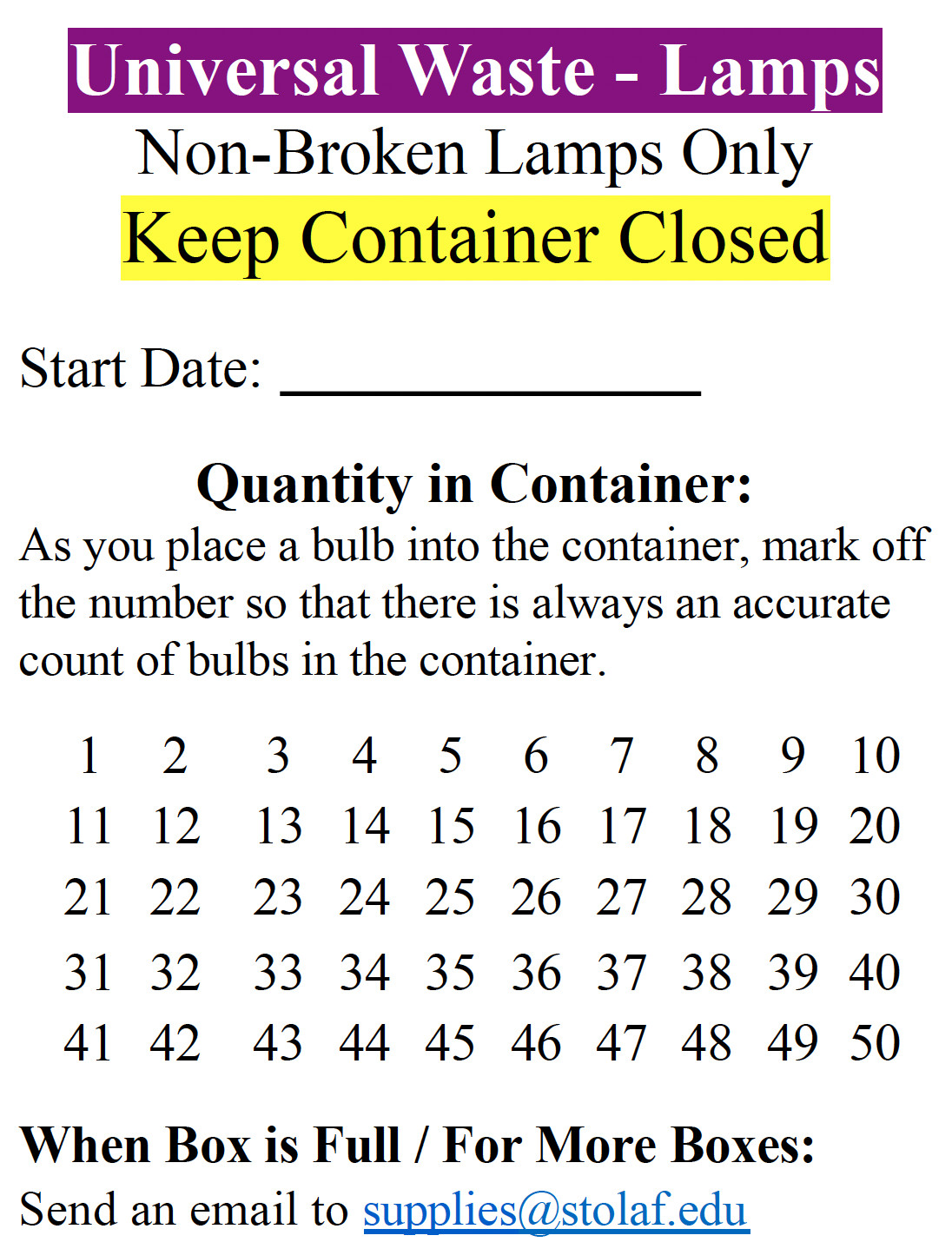
- Maintain a running inventory of the number of lamps that are in a container. This can be done by simply marking off the number for each lamp placed inside the container.
- Only NON-BROKEN lamps may be placed into the approved universal waste containers.
- DO NOT force lamps into the container. Start a new container if lamps will not glide freely into the container.
- DO NOT TAPE lamps together.
- Only same-type and same-size lamps can be placed into the same universal waste container. This means that you may require multiple containers for your building.
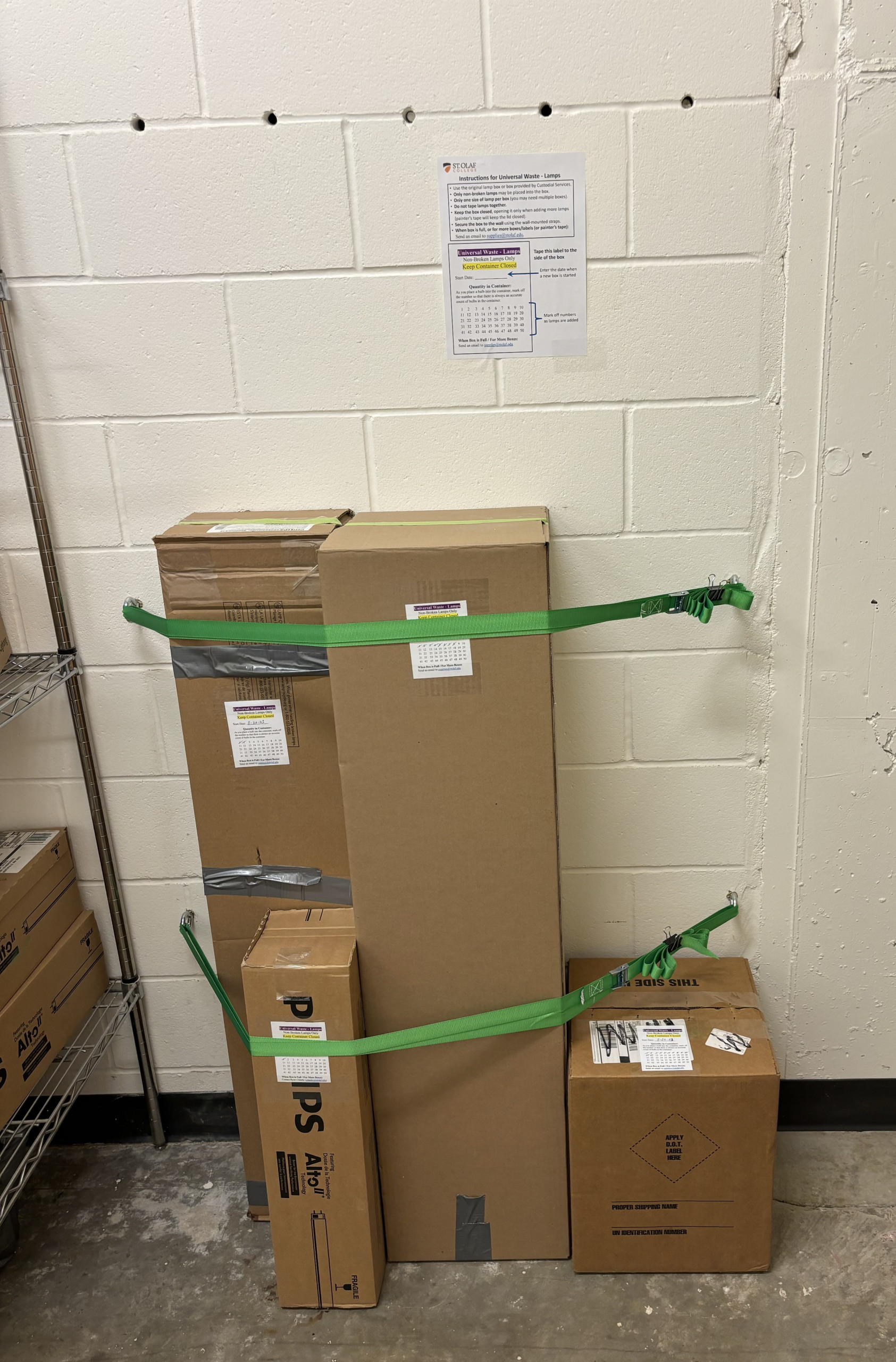
- Keep the container closed, opening it only when adding additional lamps. This can be accomplished by using painter’s tape to keep the lid closed.
- Secure the box(es) to the wall using the wall-mounted straps.
- When the container is full send an email to supplies@stolaf.edu to schedule a pickup.
If properly cleaned up, broken fluorescent lamps do not pose a serious health risk. The EPA allows for disposal of broken materials with household trash; however, MN law requires that broken lamps must be collected and taken to a hazardous waste or recycling facility.
-
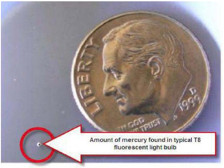
- Fluorescent light bulbs contain a small amount (2 – 5 mg) of mercury sealed within the glass tubing. When a bulb breaks, some of this mercury is released as vapor.
- As per the MN Dept of Health a brief, one-time exposure to this level of mercury vapor is not a health concern, but the most effective way to protect yourself and room occupants is to ventilate the room with outside air (if possible) and keep people out of the room for at least 15 minutes after breakage while airborne concentrations decrease.
- Some mercury still remains on the surfaces of the glass, phosphor, and the metal or plastic. The broken bulb can continue to release mercury vapor until it is cleaned up and removed from the room.
- Fluorescent light bulbs contain a small amount (2 – 5 mg) of mercury sealed within the glass tubing. When a bulb breaks, some of this mercury is released as vapor.
All Custodial staff are considered qualified to clean up residues from broken fluorescent bulbs if they follow the EPA cleanup procedures.
Before Cleanup Begins:
- If you discover a fluorescent lamp that was previously broken, you may presume that mercury vapor concentrations are sufficiently low to begin cleanup immediately.
- If you respond to a service request for a bulb that was just broken or if you are in a room where the bulb breaks, have people leave the room and ventilate the room for 10-15 minutes. If possible, open a window or door to the outdoor environment.
- Do not walk on the contaminated area. Mark or tape off the breakage area to prevent others from walking through or touching the area. Post sign(s) to not enter the area.
- Inform your supervisor. While the area is airing out, your supervisor will deliver the materials needed to clean up the broken tube/bulb: nitrile gloves, goggles, shoe covers, stiff paper or cardboard, wide sticky tape (e.g., duct tape), damp paper towels or disposable wet wipes, two resealable bags.
Cleanup Instructions:
- Put on gloves, eye protection, and shoe covers.
- Carefully and systematically scoop up glass fragments and powder using the stiff paper/cardboard, and place debris and paper/cardboard in a sealable plastic waste bag.
- Be thorough in collecting broken glass and visible powder. Do not sweep the powder/dust.
- Use sticky tape, such as duct tape, to pick up any remaining small glass fragments and powder. Place the used tape into the waste bag.
- For hard surfaces wipe clean with damp paper towels or disposable wet wipes. Place the towels in the waste bag.
- Vacuuming is not recommended unless broken glass remains after all other cleanup steps have been taken. If vacuuming is needed to ensure removal of all broken glass (after all other cleanup steps have been taken), keep the following tips in mind:
- Keep a window or door to the outdoors open.
- Vacuum the area where the bulb was broken using the vacuum hose, if available.
- Remove the vacuum bag (or empty and wipe the canister) and seal the bag/vacuum debris, and any materials used to clean the vacuum, in a plastic bag.
- Remove shoe covers and gloves and place into waste bag.
- Seal the bag and place it into a second plastic bag. Seal the outer bag as well.
- Wash your hands and face with soap and water after sealing waste bags containing lamp debris and cleanup materials.
- Your supervisor will take the bag and transfer it to the CHO for final disposal.
Cleanup Instructions for Bedding, Clothing:
- If bedding or clothing comes in direct contact with broken glass or mercury-containing powder from inside the bulb that may stick to the fabric, then the clothing or bedding should be discarded.
- If bedding or clothing has only been exposed to mercury vapors, then those items can be washed.
- If the bottom of shoes come into direct contact with broken glass or mercury-containing powder from the bulb, wipe them off with damp paper towels or disposable wet wipes. Place the towels or wipes into the plastic bag.
Future Cleaning of Carpeting:
- During the next several times that the carpet is vacuumed, before vacuuming shut off the HVAC, close the doors to other rooms, and open a window or door to the outside (if possible).
- Change the vacuum bag after each use in this area.
- After vacuuming is completed, keep the HVAC system shut off and the outside window/door open for several hours if possible or as practical.
- LED lamps are considered nontoxic and can be disposed in the regular trash in Rice County.
- However, these lamps do contain a printed circuit board, and almost every component of the bulb can be recycled, so best practice is to recycle these bulbs.
Batteries
Universal waste batteries include any electrochemical storage device that consists of an anode, cathode, and electrolyte and that would be hazardous waste when discarded, including both disposable and rechargeable categories of: lead-acid, nickel-cadmium (Ni-Cd, or NiCad), lithium, lithium-ion, silver-containing, and mercury-containing batteries.
Some batteries are not hazardous when discarded and are not considered universal waste. Common non-hazardous batteries include alkaline, carbon zinc, chloride zinc (commonly labeled as heavy duty), nickel metal hydride (NiMH), and zinc air.
Although allowed to be disposed into the normal solid waste, the MPCA still encourages recycling of non-hazardous batteries if collection is available
Aerosols and Compressed Gas Cylinders
Universal waste aerosols include any pressurized containers used to dispense liquid or gaseous products with a propellant or product that would be hazardous waste when discarded.
Universal waste compressed gas cylinders in Minnesota include any non-refillable (disposable) compressed gas cylinder with a product that would be hazardous waste when discarded.
Disposal of Containers that are not Empty.
- Contact the CHO for disposal. These containers must be accumulated properly to prevent accidental activation of the dispensing valves, such as by ensuring caps are attached or all stored upright in a single layer.
- Leaking universal waste aerosols must be accumulated in compatible, liquid-tight, labeled containers.
- Further guidance can be found on this MPCA fact sheet: https://www.pca.state.mn.us/sites/default/files/w-hw4-00.pdf.
Disposal of Containers are Empty. Containers are considered empty and can be disposed in the regular trash when both the following conditions are met:
- No liquid is felt or heard when the container is shaken by hand.
- No gas or liquid is released when the spray/discharge valve is activated and the container rotated through all directions, as long as the valve is not observably or known to be clogged.
Contact the CHO for disposal.
Pesticides
Pesticides in Minnesota include fungicides, herbicides, insecticides, nematicides, and rodenticides. Universal waste pesticides are pesticides that would be hazardous waste when discarded.
Universal waste pesticides do not include pesticides used for their intended purpose in accordance with their label instructions and Minnesota Department of Agriculture standards.
Contact the CHO for disposal.
Mercury-Containing Equipment
Universal waste mercury-containing equipment is any discarded device that contains liquid mercury integral to its function, including: thermometers, thermostats, barometers, pressure gauges, switches, relays, and pump seals. St. Olaf College actively works to become a “mercury-free” workplace, and replaces mercury-containing devices when they are discovered.
Lamps that contain gaseous or powdered mercury are universal waste lamps, not mercury-containing equipment.
Batteries that contain powdered or amalgamated mercury are universal waste batteries, not mercury-containing equipment.
Contact the CHO for proper removal and disposal.
Most mercury-containing equipment holds mercury in sealed ampoules or pellets. Do not pour or drain liquid mercury from any mercury-containing equipment.