Neuroscience Concentration (up to grad year 2029).
Students will demonstrate:
- knowledge of neuroscience, including:
- history of neuroscience;
- fundamental principles of cellular and neuron-endocrine systems;
- scientific questions addressed by neuroscientists;
- methodologies employed in neuroscience research;
- the language of neuroscience, especially pertaining to interdisciplinary dialogue.
- awareness of the scope of neuroscience including the breadth of the field, the diversity of research questions and approaches that compose it, and the thematic principles that unify and define it.
- awareness that the scope of neuroscience necessitates an interdisciplinary perspective; they will show competence in approaching a problem using tools, symbols and paradigms from multiple disciplines.
- familiarity with the scientific process, including the ability to independently
- critique and synthesize scientific literature;
- develop a testable hypothesis;
- identify and use appropriate instrumentation;
- design a controlled experiment;
- interpret data;
- communicate experimental results
- knowledge of the breadth of careers available to neuroscience students and the educational steps and other activities prerequisite to these career paths, including technical competence and the ability to identify and use appropriate professional resources.
April 2008
| Foundation Courses (taken in either order): | ||
| PSYCH 238 | Biopsychology | 1.00 |
| PSYCH 238 introduces students to the fundamental principles underlying the relationship between the brain and behavior, with an emphasis on the systems and cognitive levels. | ||
| NEURO 239 | Cellular and Molecular Neuroscience | 1.00 |
| NEURO 239 focuses on the physiology and development of neurons and neural circuits across the animal kingdom. | ||
| Select two lab electives. The first must be from the approved list of Neuroscience Core courses (see Category A list). The second may be from either Category A or Category B. If the second is NOT from Category A, it must be from Category B and from a different department. (See Category B list). | 2.00 | |
| Elective: | 1.00 | |
| Any course from Category A, B, or C. (See lists on courses tab.) | ||
| One level III seminar | 1.00 | |
| Total Credits | 6.00 | |
Neuroscience Major (grad year 2030 and onwards).
- Students will describe the basic structure and function of the nervous system at multiple levels of organization (e.g. spanning from molecules to cells to circuits to systems to behavior).
- Students will be able to perform experiments using tools, techniques, strategies, and terminology to answer neuroscience questions across multiple levels of organization of the nervous system.
- Students will critically analyze the primary neuroscience literature by:
- effectively searching and locating relevant primary literature for a given neuroscience topic
- independently identifying the research question(s) addressed
- evaluating the appropriateness of experimental design and methods
- interpreting data such as images, graphs, and numerical results
- synthesizing multiple sources to review the current state of a subfield within neuroscience, including important unanswered questions
- Students will communicate neuroscience findings:
-
- that include their own as well as the results of others
- in oral, graphical, or written form
- to a variety of audiences such as the general public, peers, or professional neuroscientists
- Students will reflect on the breadth of careers available to neuroscience students and the educational steps and other activities prerequisite to these career paths.
View in Catalog
| Course Code | Course Name | Credits Required |
| Gateway to the Neuroscience Major | ||
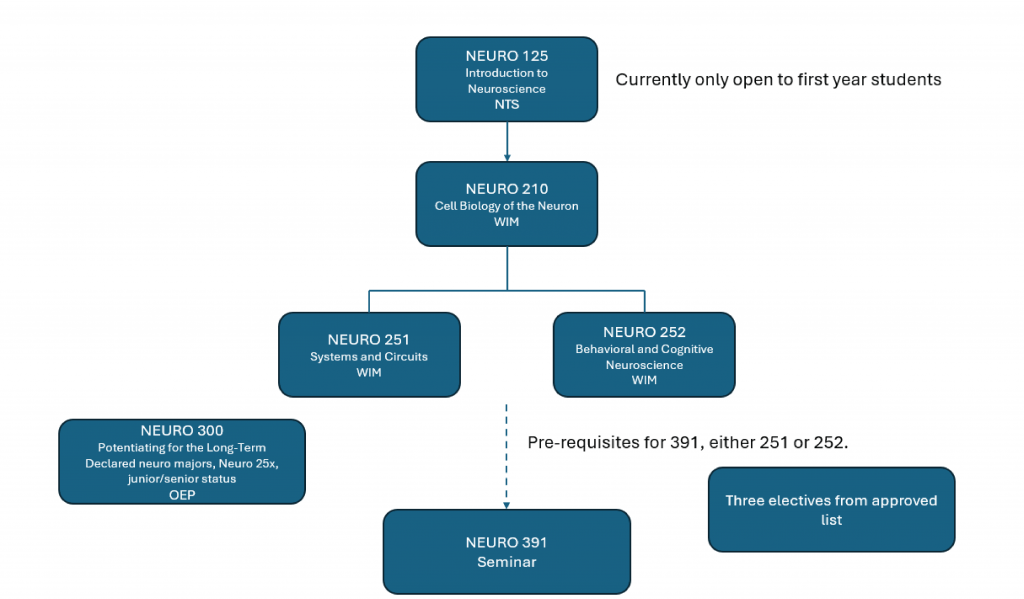
| NEURO 125 | Introduction to Neuroscience
Ole Core: Natural Science |
1 |
| Core Courses | ||
| NEURO 210 | Cell Biology of the Neuron
WIM; publication quality figures |
1 |
| NEURO 251 | Systems and Circuits
WIM: oral presentations (talks) |
1 |
| NEURO 252 | Behavioral and Cognitive Neuroscience
WIM: poster presentations |
1 |
| Advanced Integrative Experiences | ||
| NEURO 300 | Potentiating for the Long-Term
Ole Core: Experience in Practice |
0.25 |
| NEURO 391 | Special Topics Seminar
WIM: grant proposal or literature review |
1 |
| Electives | ||
| Various | Elective 1 | 1 |
| Various | Elective 2 | 1 |
| Various | Elective 3 | 1 |
| Total | 8.25 | |
You must be logged in to post a comment.