Teaching at St. Olaf
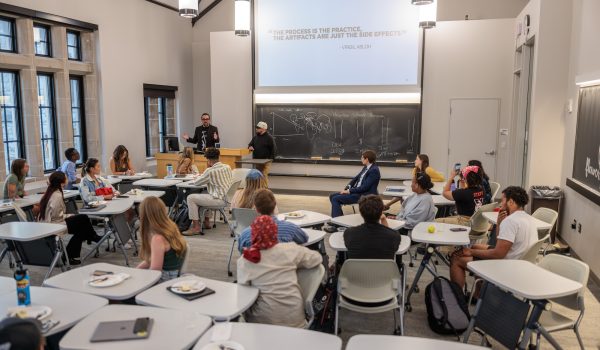
Getting to Know You Survey Example
How to Teach a Good First Day of Class, by James M. Lang for the Chronicle of Higher Education; see also his book, On Course: A Week-by-Week Guide to Your First Semester of College Teaching.
How to set up your access to the Chronicle of Higher Education, New York Times and Wall Street Journal
Making the Right Impressions on the First Day of Class
Ideas for Group Work and Student Engagement
The First Day of Class
Center for Teaching and Learning, University of Washington.
Some Specific Approaches for the First Day of Class, Peter Frederick, Wabash College.
101 Things You Can Do in the First Three Weeks of Class, Office of Graduate Studies, University of Nebraska-Lincoln.
Getting Started, Richard Felder and Rebecca Brent, North Carolina State University.
The First Day and Week of Class: Instructional Strategies, Joe Cuseo, Marymount College.
Make the Most of the First Day of Class, Eberly Center, Carnegie Mellon University
First Day of Class Activities that Create a Climate for Learning, MaryEllen Weimer onThe Teaching Professor Blog
First Day of Class, Center for Teaching, Vanderbilt University
Resources in the CILA library:
“The First Days of Class” in Barbara Gross Davis, Tools for Teaching (pp. 37-47). Jossey-Bass, 2nd edition, 2009.
“Meeting a Class for the First Time” in Svinicki and McKeachie, McKeachie’s Teaching Tips: Strategy, Research and Theory for College and University Teachers (pp. 19-25). Wadsworth, 14th edition, 2011.
Angela Provitera McGlynn, Successful Beginnings for College Teaching: Engaging Your Students from the First Day. Atwood Publishing, 2001.
“First Days of Class” in James M. Lang, On Course: A Week-by-Week Guide to Your First Semester of College Teaching, Harvard University Press, 2008.
IT Help Desk – Access how-to articles and submit all technology-related questions and issues, including those related to classroom technology, laptop and office tech, software, Moodle and other teaching technologies.
Library Homepage – Search our catalog to locate resources for teaching and research. Set up appointments with liaison librarians, and submit requests for additional materials.
College Library Archives – The College Archives, currently housed on the second floor of the Rølvaag Memorial Library preserves college collections for future generations; making them more discoverable for our students, faculty and researchers; and bringing them to life in our classrooms.
Digital Scholarship Center at Olaf (DiSCO) – Located in the Rolvaag library, we offer support for digital assignments, audio and video recording spaces, and a makerspace. LITS Instructional Staff are also available for consulations.
LibGuide — Teaching with Special Collections and College Archives
LibGuide — New Faculty Introduction
Sample Moodle Syllabus
Design Thinking Overview – From the IDEO organization, “Design thinking is a human-centered approach to innovation—anchored in understanding customer’s needs, rapid prototyping, and generating creative ideas”
Vision for Equity and Inclusion at St. Olaf
St. Olaf Guidelines Around Grading (Registrar’s Website)
“Equity in Assessment,” St. Olaf College
St. Olaf Gender and Sexuality Pronouns Page, Features things to keep in mind when identifying or asking other people to identify their pronouns, including that some people may only want to be referred to by their name
Includes instructions for faculty and staff on how to add their pronouns to the directory
I. Teaching Resources
- Trans* Inclusion in the Classroom: Tips for the First Day of Class
Duke Learning Innovation
– Encourages sending a pre-class questionnaire that includes asking students to clarify the name they would like to be called and their pronounsAsking Others Their Pronouns
MyPronouns.org
– Includes advice on inviting people to share their pronouns in a large group introduction. It is recommended to never force someone to share their pronouns.How to add name pronunciation in the directory for faculty and staff:
– Log into stoFaces at www.stolaf.edu/stoface
– Click Name Pronunciation from the navigation menu
– Follow the directions on the screen - Diversity, Equity, and Inclusion Glossary of Terms by St. Olaf’s To Include is to Excel initiative
- How to Make Your Teaching More Inclusive, by Viji Sathy and Kelly A. Hogan for the Chronicle of Higher Education
- How to Hold a Better Class Discussion, by Jay Howard for the Chronicle of Higher Education
- Microaggressions and Microinterventions in the Classroom (FSU)
- Inclusive Teaching Resources The Schreyer Institute for Teaching Excellence. Penn State
- “Becoming an Anti-Racist Educator” Center for Collaborative Teaching and Learning, Wheaton College
- “Responding to Difficult Moments” Center for Research on Learning and Teaching , U Michigan
II. Some history, contexts, challenges and ongoing responses at St. Olaf and beyond
- “Where the Inequity Lies” Avery Ellfeldt, Manitou Messenger, May 2019. (Link not working.) Here is one piece from the Messenger that speaks to the events of 2017
- “Language Action for Course Syllabi” Adhoc Faculty Group, St Olaf College
- Task Force to Dismantle Structural Racism at St Olaf College. First Agenda and First Meeting Video
Academic Success Center Services
CIR Poster – First Year Experience
Disability, Access, and Limits of Reasonable Accommodation – video recording of CILA session
Additional College Resources and Offices
Registrar’s Office – Click on “Menu” then “Privacy” to learn about key FERPA guidelines.
College Catalog – Learn about the St. Olaf Curriculum, academic regulations and policies, find a list of departments, and so much more.
Student Information System (SIS) – Here you can access your class roster, see the course catalogue, and find important forms. This is also where you will submit grades.
Dean of Students Office – Click “Menu” and “For Faculty” to learn about the Early Alert System, an important tool for faculty to alert the Associate Deans about individual students encountering academic and personal difficulties. The Associate Deans assist students in need, connecting them with support and resources.
The Honor Council – To report a potential Honor Code violation, there is now a Google Form for faculty members to use: Report Exam Concern to Honor Council. This form can be used when you have an unsigned pledge or when you want to report your own suspicions.
Academic Success Center – The Academic Success Center helps our students maximize their potential as learners. The Academic Success Center offers peer tutoring, group study, workshops, one-on-one coaching as well as disability and access services. The Academic Success Center also works with faculty to support academic advising.
Library and IT Resources: New Faculty Libguide – Would you like a research and instruction librarian to teach your students how to use library resources and therefore do better research? Do you have technology requests for your classroom or for your own research? This is a one-stop-shop for all your library- and information technology-related needs. You can have students sign up for a research consultation, meet with a student research tutor, and more!
Send students to the Writing Desk for help with any writing assignments. Writing tutors will discuss drafts with students (NB: they won’t just give feedback; there’s always a conversation), help students work through any writing challenges they face, and offer process-oriented guidance.
Our outstanding team of Research and Instruction Librarians are available to meet with students. Arrange a 20-minute research appointment by clicking here. Student research tutors are also available to work with your students. Again, contact a Research Librarian for more information.
The Taylor Center supports College-wide equity and inclusion efforts, with particular focus on creating a safe, inclusive space for students.
Counseling Center – The Center offers a variety of services and programs, including individual counseling, group counseling, workshops, testing, consultation and referrals. Services are provided without cost to all currently enrolled St. Olaf students.
To Include is To Excel – The “To Include is to Excel Project” was a four–year, $800,000 initiative funded by the Andrew W. Mellon Foundation whose purpose was to stimulate equity-oriented faculty development and support curricular transformation to serve new generations of students.
Lutheran Center for Faith, Values, and Community – Established in 2019, the Lutheran Center encourages the interreligious exploration of faith, values and vocation and provides opportunities for students, faculty, staff, and alumni to connect with each other around questions of belief, meaning, purpose and life choices. See especially “Rooted and Open” – a missive from the Evangelical Lutheran Church in America (ELCA) on being a Lutheran-identified college in the 21st century.
The Faculty/Staff page on St. Olaf website – As a starting place to find many of the previous items and more
Center for Innovation in the Liberal Arts (CILA) – That’s us! Find more teaching resources here, as well as a schedule of upcoming events and recordings of past events.
Previous New Faculty Workshops
The 2020 fall orientation for new faculty took place virtually on August 10-11. Below, the orientation is broken down into Day 1 and Day 2, and under each day is a guide to the activities and resources for each session. Video recordings of the panel on small groups and teamwork and the session on inclusive and efficient evaluation are under Day 1 and Day 2, respectively. Below the two orientation sections are resources that were suggested by new faculty during orientation.
Orientation: Day 1
Day 1 Activities and Resources
Faculty members Louis Epstein, Peter Gittins, and Paul Jackson lead a panel on small group work and teamwork.
Orientation: Day 2
Day 2 Activities and Resources
Associate Director of Writing, Speaking, and Academic Support and Adjunct Assistant Professor of Writing Bridget Draxler leads a session on inclusive and efficient evaluation practices.
Resources Suggested by New Faculty During Orientation
Make It Stick: The Science of Successful Learning
Brown, Peter; Roediger, Henry; McDaniel, Mark (Cambridge: Harvard University Press, 2014). Offers concrete techniques for more productive and successful learning.
A blog from artist and writer Salomé Voegelin about sounds and words. Suggested by a faculty member as potential movement exercises that can be used to break up online screen time.
A fun way for your students to get to know each other.
American Indian Science and Engineering Society
The American Indian Science and Engineering Society (AISES) is a non-profit focused on supporting and increasing the number of indigenous peoples of North America in STEM fields. This page is a list of their publications.
Minnesota 511 Travel Information
This website run by the MN Department of Transportation provides up-to-date information on road conditions, weather reports, and traffic incidents on Minnesota roads. You can also download the Minnesota 511 app.